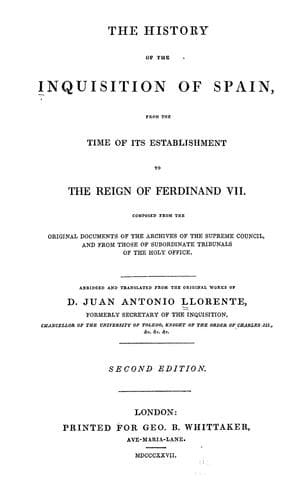
The History of the Inquisition of Spain from the Time of its Establishment to the Reign of Ferdinand VII.Llorente, Juan Antonio
History
The History of the Inquisition of Spain from the Time of its Establishment to the Reign of Ferdinand VII.
Llorente, Juan Antonio
Inquisition -- Spain
Charles V. was then at Brussels, occupied in ceding the empire of
Germany to his brother Ferdinand, King of Hungary and Bohemia, and in
making over the crown of Spain and the countship of Flanders to his son.
This policy was useful to Charles V., as it threw the weight of the
embarrassment on Philip, who had just arrived from England to receive
his father's instructions how to govern Spain. The circumstances in
which they found themselves required the greatest prudence, for they not
only had to fear the abuse which the Pope might make of his apostolical
and temporal power, but also the consequences of the alliances which his
holiness had just signed with the King of France.
Besides the Council of State (which Charles and Philip always consulted
before they decided on any subject) they deemed it necessary to have
judgments of _conscience_, to balance the authority of the supreme head
of the Catholic Church. On the 15th of November, 1555, the famous
consultation of Brother Melchior Cano was framed at Valladolid, which
was published at Madrid in 1809, in my _collection of different papers,
ancient and modern, on matrimonial dispensations, and other
ecclesiastical dispensations_. The decision of Cano was, that in all
similar cases the only and proper remedy is not only to deprive the
temporal sovereign of Rome of the power of injuring, but to reduce him
to the necessity of accepting reasonable terms, and of acting with more
prudence in future. Other theologians decided that the concessions made
by the Court of Rome were irrevocable, and had the force of a true
contract passed for the benefit of an empire or kingdom.
The Pope, informed of these decisions, commanded the inquisitor-general
to punish the authors of it; he was supported by most of the prelates of
the kingdom, at the head of whom was the Cardinal Siliceo, Archbishop of
Toledo, who had been the king's preceptor. Philip, who had been King of
Spain from January, 1556, wrote from London, in the month of July
following, the letter to his sister, the governess of the kingdom, which
I have inserted in my diplomatic collection. It is as follows:--
Public-domain text, read in full here on John Shaqi.
Reviews
Reviews
No reviews yet
Be the first to share your thoughts on this work.
Elsewhere in the archive
Join the Discussion
Join the discussion
Sign in to leave a comment or review.
Sign InorCreate an account