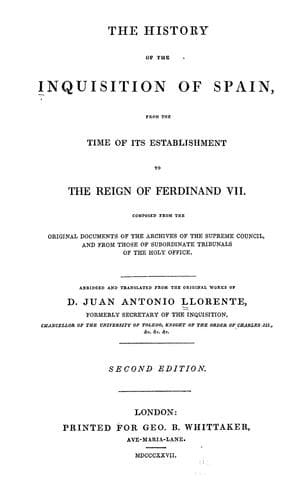
The History of the Inquisition of Spain from the Time of its Establishment to the Reign of Ferdinand VII.Llorente, Juan Antonio
History
The History of the Inquisition of Spain from the Time of its Establishment to the Reign of Ferdinand VII.
Llorente, Juan Antonio
Inquisition -- Spain
and this prohibition must extend to the kingdom of Aragon, to which you
must write if it is necessary. It has been since known, that in the bull
published on Holy Thursday, the Pope has excommunicated all those who
have taken or shall take the property of the church, _whether they are
kings or emperors_, and that on Good Friday, he commanded the prayer for
his majesty to be omitted, although the Jews, Moors, heretics, and
schismatics are prayed for on that day. This proves that the evil is
becoming serious, and induces us to recommend more particularly the
execution of the measures which we have prescribed, and of which we
shall give an account to his majesty[15]."
Philip, for the time, prevented the inquisitor-general from trying any
of those persons who had been marked as suspected of heresy, among whom
were not only the theologians and canonists who had been consulted, but
many counsellors of state who supported their opinion against Cardinal
Siliceo and his adherents[16].
The Pope was obstinate in his resolutions; and deceived by the
tranquillity which Philip suffered him to enjoy in Rome, he placed
himself at the brink of the precipice. The Duke of Alva, who was viceroy
of Naples (and whose character was at least as harsh as that of the
Pope), in September 1556, left his government, and occupied the states
of the holy see, even to the gates of Rome; and Paul IV., finding that
the republic of Venice had deserted him, and being pressed by the
cardinals and people, demanded an armistice, which was granted. Instead
of taking advantage of this favour to make peace on reasonable terms,
the Pope confirmed his alliance with Henry II., and raised a war between
that monarch and the King of Spain, although Charles V. had, in 1555,
signed a truce of five years with that prince. Henry, having lost the
famous battle of St. Quentin, on the 10th of August, 1557, the Pope
became so alarmed, that he demanded a peace at the time when the Duke of
Alva was preparing to enter Rome at the head of his army. The viceroy
renounced his design, but had the boldness to tell the Pope that he
would not make peace until he had asked pardon of the king, his master,
for having treated him with so little respect. This message increased
the alarm of the old pontiff, who had recourse to the mediation of
Venice. The Pope refused to negociate with the Duke of Alva, but said
that he would consent to any proposal from the King of Spain, as he was
persuaded that he would not impose any condition on him contrary to his
honour, or to the dignity of the holy see.
Public-domain text, read in full here on John Shaqi.
Reviews
Reviews
No reviews yet
Be the first to share your thoughts on this work.
Elsewhere in the archive
Join the Discussion
Join the discussion
Sign in to leave a comment or review.
Sign InorCreate an account