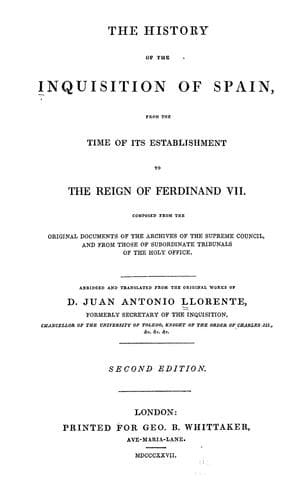
The History of the Inquisition of Spain from the Time of its Establishment to the Reign of Ferdinand VII.Llorente, Juan Antonio
History
The History of the Inquisition of Spain from the Time of its Establishment to the Reign of Ferdinand VII.
Llorente, Juan Antonio
Inquisition -- Spain
The Duke of Alva wrote to Philip, to request that, in this instance, he
would display the severity necessary to prevent new divisions. But this
prince (who had signed on the 10th of July, 1556, the excellent letter
already quoted) had no person in the following year to inspire him with
sufficient energy to follow the advice of his viceroy. He wrote to
command him to conclude a peace immediately, "as he would rather lose
the privileges of his crown, than infringe those of the holy see in the
slightest degree."
The Duke of Alva was extremely displeased at this resolution, but he
immediately obeyed his master, and this singular peace was signed on the
14th of September, 1557, by the Duke of Alva, and Cardinal Carafa,
nephew and plenipotentiary to the Pope. The envoy made no reparation to
Philip II., and the following singular article is part of the
treaty:--"His holiness will receive from the Catholic king, through his
plenipotentiary, the Duke of Alva, all the necessary submissions to
obtain the pardon of his offences, without prejudicing the engagement of
the king to send an ambassador extraordinary for the particular object
of the pardon which he demands, it being understood that his holiness
will restore him to favour as a submissive son, and worthy to share the
benefits which the holy see is accustomed to bestow on its children and
the other Christian princes."
The haughty pontiff acknowledged that he had obtained more than he had
hoped for, and to show his satisfaction, bestowed the highest honours on
the Duke of Alva; he invited him to eat at his own table, and received
him in the palace of the Vatican.
Gregorio Leti is right in attributing all the evils that have since
arisen from the excessive authority which the priests have arrogated
over laymen, to this conduct of Philip II. Paul IV. soon displayed his
contempt for Philip II. and his father, since, in five months after the
treaty, on the 13th of February, 1558, he addressed a brief to the
inquisitor-general Valdés, in which he revived all the regulations of
the councils and pontiffs against heretics and schismatics. He commanded
him to prosecute them, and punish them according to the constitutions,
and, above all, to deprive all such persons of their dignities and
offices, whether they were bishops, archbishops, patriarchs, cardinals,
or legates, _barons, counts, marquisses, dukes, princes, kings, or
emperors_. Fortunately, neither Charles V. nor his son had embraced the
opinions of Luther, yet it was certainly the intention of the Pope to
subject them to the dispositions of his bull.
_Of the Inquisitions of Sardinia, Flanders, Milan, Naples, Galicia,
America, and the Sea._
In 1562, Philip II. commanded the Inquisition of Sardinia to conform
rigorously to the rules of the holy office of Spain in prosecuting the
accused, although it was represented to him that they had hitherto only
known those of Ferdinand V., which were less severe.
Public-domain text, read in full here on John Shaqi.
Reviews
Reviews
No reviews yet
Be the first to share your thoughts on this work.
Elsewhere in the archive
Join the Discussion
Join the discussion
Sign in to leave a comment or review.
Sign InorCreate an account