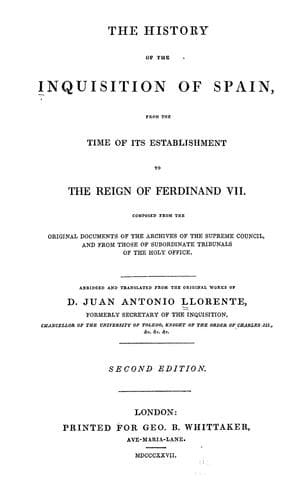
The History of the Inquisition of Spain from the Time of its Establishment to the Reign of Ferdinand VII.Llorente, Juan Antonio
History
The History of the Inquisition of Spain from the Time of its Establishment to the Reign of Ferdinand VII.
Llorente, Juan Antonio
Inquisition -- Spain
This project was the more dreaded, as many Spaniards had fled from the
Inquisition to Holland. These emigrations were most numerous after the
year 1550, when several Bibles, which had been printed in the Spanish
language in the Low Countries, were prohibited as containing the
opinions of the new heretics. Notwithstanding the obstinacy with which
the King of Spain pursued the establishment of the Inquisition in
Flanders, he failed in his enterprise, and also in his attempt to force
the Low Countries to receive the regular tribunal. The Flemings
persisted in opposing everything resembling the Inquisition, and their
resistance was the cause of the long and bloody wars which exhausted the
treasures and armies of Spain during half a century.
In the following year, 1563, Philip II. decreed the necessary measures
to establish the Inquisition at Milan. He communicated his design to the
Pope, who appeared to approve it, but was really displeased, because it
tended to diminish the power of the holy see. The Milanese immediately
protested against the introduction of a tribunal, of which they had
formed the most unfavourable opinion. The bishops of Lombardy were not
less averse to it, as they knew that in Spain the bishops were not only
deprived of all power, but had fallen into contempt from the despotism
of the inquisitors, who had taken possession of the episcopal
privileges, and enjoyed them in peace under the protection of the
sovereign, who had no adviser in these affairs but the
inquisitor-general.
The city of Milan sent deputies to the Pope (who was a native of that
place), to entreat him to preserve his country from the danger which
threatened it. They also sent deputies to Madrid to demand that things
should remain in the same state, and applied at the same time to the
Milanese bishops at the Council of Trent to support their cause before
that celebrated assembly. Pius IV. told the deputies that he would never
allow the Spanish Inquisition to be established in Milan, _as he knew
its extreme severity_, and promised that their tribunal should be
dependent on the Court of Rome, whose decrees were extremely mild, and
gave the accused every facility in their defence.
During the course of this negotiation, the Duke de Sesa, wishing to
execute his master's private orders, established the tribunal of the
Inquisition in the city of Milan, of which he was the governor, and
published the names of the sub-delegated inquisitors. This declaration
displeased the Milanese, who began to excite popular commotions, and
cried _Long live the king! perish the Inquisition!_
Public-domain text, read in full here on John Shaqi.
Reviews
Reviews
No reviews yet
Be the first to share your thoughts on this work.
Elsewhere in the archive
Join the Discussion
Join the discussion
Sign in to leave a comment or review.
Sign InorCreate an account