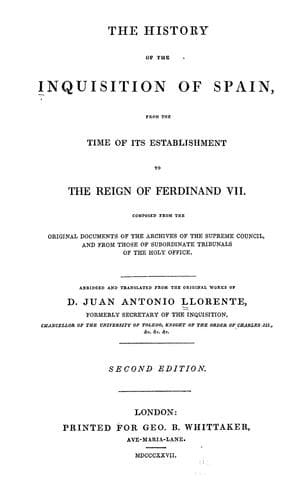
The History of the Inquisition of Spain from the Time of its Establishment to the Reign of Ferdinand VII.Llorente, Juan Antonio
History
The History of the Inquisition of Spain from the Time of its Establishment to the Reign of Ferdinand VII.
Llorente, Juan Antonio
Inquisition -- Spain
Philip did not treat his Flemish subjects with less rigour. In 1522
Charles V. appointed Francis de Hult, a lay counsellor of Brabant,
inquisitor-general for the states of Flanders; and Adrian VI. invested
him with the apostolical jurisdiction, on the condition that he had
priests and theologians for assessors. Soon after three provincial
inquisitors were appointed, the overseer of the regular canons of Ypres
for Flanders and its dependencies; the overseer of the clergy of Mons
for Hainault, and the Dean of Louvain for Brabant, Holland, and the
other provinces. The inquisitors-general appointed by Clement VII. were
Cardinal Everard de la Marche, Bishop of Liege, and Francis de Hult,
before mentioned. This measure did not deprive the other inquisitors of
their privileges; those of Louvain, in 1527, celebrated several
_autos-da-fé_, and condemned sixty persons to different punishments. In
1529 terrible edicts were issued against heretics, which were renewed in
1531, but with some mitigation.
At the death of the Dean of Louvain, Paul III. in 1537, appointed as
inquisitor-general for the Low Country the successor in the deanery, and
the canon Douce; they were approved by Charles V. In 1555 Julius III.
authorised the sub-delegates of the dean and canon; Paul IV. did the
same in 1560 for the overseer of Valcanet, and the theological doctor of
Louvain, Michael Bayo. All these men took the title of _ecclesiastical
ministers_ from the year 1550, when Charles V. prohibited them from ever
taking the name of _inquisitors_, because it was obnoxious to the
people. The Flemish Inquisition was extremely severe in the first period
of its existence; it inflicted the same punishments as that of Spain,
but applied them to a greater number of cases. Philip II. moderated the
action of this tribunal by an edict in 1556.
Such was the state of the Flemish Inquisition in 1559, when a bull of
Paul IV. was received from Rome, by which three ecclesiastical provinces
were created, the bishoprics of which were subjected to the jurisdiction
of the Archbishops of Malines, Cambray, and Utrecht: twelve canons were
instituted for each cathedral, three of whom were to be inquisitors for
life. This measure caused the first indication of the rebellion which
raged in Holland and the United Provinces in 1562. The people maintained
that they had only tolerated the inquisitors since 1522, because they
considered them as temporary agents; but that they would never allow the
permanent establishment of an institution so obnoxious to the provinces.
This opposition increased when it was known that Philip II. intended to
organize the eighteen Inquisitions of Flanders, on the plan of that of
Spain, which had long been regarded as a sanguinary tribunal.
Public-domain text, read in full here on John Shaqi.
Reviews
Reviews
No reviews yet
Be the first to share your thoughts on this work.
Elsewhere in the archive
Join the Discussion
Join the discussion
Sign in to leave a comment or review.
Sign InorCreate an account