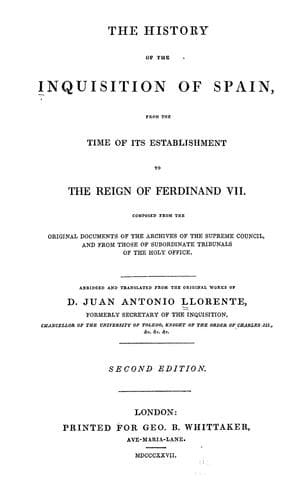
The History of the Inquisition of Spain from the Time of its Establishment to the Reign of Ferdinand VII.Llorente, Juan Antonio
History
The History of the Inquisition of Spain from the Time of its Establishment to the Reign of Ferdinand VII.
Llorente, Juan Antonio
Inquisition -- Spain
The trial of Juan Gil, Bishop of Tortosa, so much alarmed many
Lutherans, that they quitted the kingdom. Of this number were
Cassiodorus de Beina, Juan Perez de Pineda, Cyprian de Valera, and
Julian Hernandez; the three first published catechisms, translations of
the Bible, and other works written in the Castilian tongue, in foreign
countries[19]. Juan Perez published his at Venice in 1556, and they were
soon after introduced into Spain by Hernandez, who was arrested by the
Inquisition. The citations and inquiries made in consequence of the
trial of Hernandez, in order to discover the religious opinions of the
persons with whom he associated, caused an infinite number of trials to
be instituted during the fifteen years following, in all the tribunals
of Spain, particularly in those of Seville and Valladolid. In 1557 and
1558, the Inquisition arrested a great number of persons distinguished
by their birth, their offices, or their doctrine. Some indications found
in the writings of the trials, of a vast scheme tending to the
propagation of the opinions of Luther, persuaded Philip II. and the
inquisitor Valdés that it was necessary to treat all the convicted
persons with the utmost severity. Philip wrote to Rome on the subject on
the 4th January, 1559. The Pope addressed to Valdés a brief, in which he
authorized him to give over to secular justice all dogmatizing
Lutherans, even those who had not relapsed, and who, to avoid capital
punishment, had given equivocal signs of repentance. If history had
nothing to allege against Philip II. and the inquisitor Valdés, but the
solicitation for this bull, it would be sufficient to devote their names
to infamy.
On the 5th of January, 1559, a second bull revoked all the permissions
granted for reading prohibited books, and charged the inquisitor-general
to prosecute all who should read or keep them in their houses; and as
his Holiness was informed that a great number of writings which tended
to propagate the Lutheran doctrines were circulating in Spain, the bull
commanded the confessors to ask their penitents if they knew or had
heard of any persons possessing, reading, or dispersing them; that they
should also impose upon them the obligation of communicating such
circumstances to the holy office on pain of excommunication; and that
the confessors who omitted this duty should be punished as guilty, even
if persons they absolved were bishops, archbishops, patriarchs,
cardinals, _kings_, or _emperors_. It is easy to perceive how much these
measures must have increased the number of accusations; and to encourage
the informers, Philip renewed the edict of Ferdinand V., published at
Toro in 1505, by which they were entitled to the fourth part of the
confiscated property.
Public-domain text, read in full here on John Shaqi.
Reviews
Reviews
No reviews yet
Be the first to share your thoughts on this work.
Elsewhere in the archive
Join the Discussion
Join the discussion
Sign in to leave a comment or review.
Sign InorCreate an account