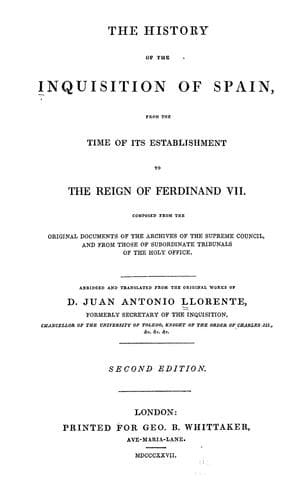
The History of the Inquisition of Spain from the Time of its Establishment to the Reign of Ferdinand VII.Llorente, Juan Antonio
History
The History of the Inquisition of Spain from the Time of its Establishment to the Reign of Ferdinand VII.
Llorente, Juan Antonio
Inquisition -- Spain
Francis de Vibero Cazalla, brother to Augustin, a priest, and Curate of
Hormigos in the diocese of Palencia, at first denied the charges,
confessed them when tortured, ratified his confession, and demanded to
be admitted to reconciliation. This was refused, as it was supposed that
he had only confessed from the fear of death. In fact, he ridiculed his
brother's exhortations on the scaffold, and expired in the flames
without showing any signs of repentance. He was degraded from the
priesthood, as well as his brother, before he ascended the scaffold.
Donna Beatrice de Cazalla, sister to the above-mentioned persons, and
Alphonso Perez, at first denied the charges, confessed during the
torture, demanded reconciliation, but were strangled and burnt.
Don Christobal de Ocampo, of Seville, a knight of the order of St. John,
and almoner to the Grand Prior of Castile and Leon, and Don Christobal
de Padilla, a knight and inhabitant of Zamora, were condemned to the
same punishment for Lutheranism.
The licentiate Antonio Herrezuelo, a lawyer of the city of Toro,
condemned as a Lutheran, died without any signs of repentance. Doctor
Cazalla addressed some words to him in particular; Antonio ridiculed his
discourse, although he was already fastened to the stake. One of the
archers, furious at so much courage, plunged his lance into the body of
Herrezuelo; he died without uttering a word.
Juan Garcia, a goldsmith of Valladolid, and the licentiate Perez de
Herrera, judge of the court against smugglers, in Logrono, suffered as
Lutherans. Gonzalez Baez, the Portuguese mentioned in the preceding
chapter, suffered as a Judaic heretic.
Donna Catherine de Ortega, widow of the commander Loaisa, and daughter
to Hernand Diaz, fiscal of the Royal Council of Castile, was condemned
as a Lutheran, and made her confession. She suffered the same fate with
Catherine Roman de Pedrosa, Isabella d'Estrada, and Jane Blazquiez, a
servant of the Marchioness d'Alcanizes. None of these persons had
dogmatized, none had relapsed, but they were condemned because they only
confessed during the torture.
Among the persons reconciled were distinguished,--Don Pedro Sarmiento de
Roxas, a knight of the order of St. Jago, commander of Quintana, and the
son of the first Marquis of Poza. He was condemned as a Lutheran,
deprived of his orders, clothed in the perpetual _San-benito_,
imprisoned for life, devoted to infamy, and his property confiscated.
Don Louis de Roxas, nephew of the above, was charged with the same
crime; he was exiled from Madrid, Valladolid, and Palencia, and
prohibited from leaving Spain; his property was confiscated, and he was
declared incapable of succeeding to the marquisate of Poza, which passed
to his youngest brother.
Donna Mencia de Figueroa, wife of Don Pedro Sarmiento de Roxas, and an
attendant of the Queen of Spain, was condemned, for Lutheranism, to wear
the _San-benito_, to imprisonment for life, and the confiscation of her
property.
Public-domain text, read in full here on John Shaqi.
Reviews
Reviews
No reviews yet
Be the first to share your thoughts on this work.
Elsewhere in the archive
Join the Discussion
Join the discussion
Sign in to leave a comment or review.
Sign InorCreate an account