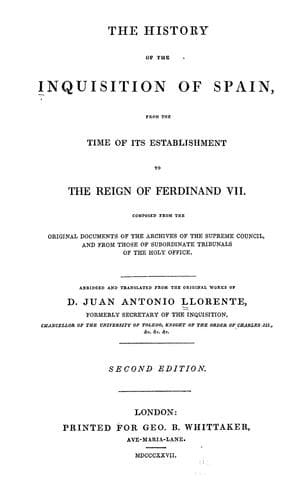
The History of the Inquisition of Spain from the Time of its Establishment to the Reign of Ferdinand VII.Llorente, Juan Antonio
History
The History of the Inquisition of Spain from the Time of its Establishment to the Reign of Ferdinand VII.
Llorente, Juan Antonio
Inquisition -- Spain
year to Spain, and retired to Salamanca, where he lived for three years,
going sometimes to Valladolid. He once attended, by the emperor's order,
at an assembly where Don Antonio Fonseca, president of the Royal Council
of Castile, presided, and at which the Licentiate Otalora, the Doctors
Ribera and Velasco, auditors of the council and chancery, and Brothers
Alphonso de Castro and Bartholomew Carranza assisted. The object of the
meeting was to decide on the course to be pursued on the occasion of
certain briefs which the Court of Rome had expedited against those who
approved of the decrees of the Council of Trent, which continued to
assemble in that city, though the Pope had commanded that it should be
transferred to Bologna. Cazalla declared that all the members of the
junta acknowledged that the Pope only acted from motives of personal
interest; and that Bartholomew Carranza particularly distinguished
himself by inveighing against the abuses of the Court of Rome. On the
20th of May, the day before his death, he received a visit from Brother
Antonio de la Carrera, a monk of St. Jerome, who was sent to him by the
inquisitors, to inform him that they were not satisfied with his
declarations, and to exhort him, for the good of his conscience, to
confess all that he knew of himself and others. Cazalla answered, that
he could not say more, without bearing false-witness. The monk replied,
that he had always denied that he had dogmatized, though the contrary
was proved by the witnesses. He said, that this crime had been unjustly
imputed to him; that he was guilty of not having undeceived those who
held bad doctrines; but that he had only spoken of his opinions to
persons who thought as he did: Brother Antonio then exhorted him to
prepare for death on the following day. This information was a
thunderbolt to Cazalla, who had expected to be admitted to a
reconciliation. He demanded if his punishment might not be commuted:
Carrera told him, that if he confessed what he had hitherto concealed,
he might hope for mercy. _Well then_, said Cazalla, _I must prepare to
die in the grace of God; for it is impossible that I should add anything
to what I have already said, unless I lie_. He then began to encourage
himself to suffer death; he confessed several times in the same night,
and the next day to Antonio de la Carrera. When he arrived at the place
of the _auto-da-fé_, he asked permission to preach to those who were to
suffer with him; he could not obtain it, but he addressed a few words to
them: as he was a penitent, he was strangled before, he was burnt. When
he was fastened to the stake, he confessed for the last time, and his
confessor was so affected by all that he had seen and heard during the
last twenty-four hours, that he afterwards wrote, "that he had no doubt
that Doctor Cazalla was in Heaven."
Public-domain text, read in full here on John Shaqi.
Reviews
Reviews
No reviews yet
Be the first to share your thoughts on this work.
Elsewhere in the archive
Join the Discussion
Join the discussion
Sign in to leave a comment or review.
Sign InorCreate an account