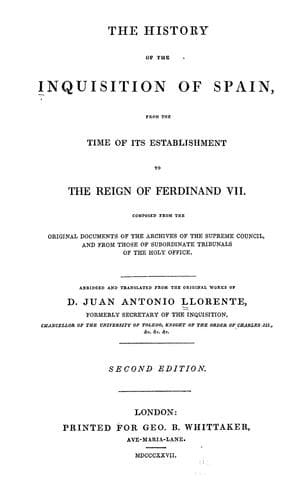
The History of the Inquisition of Spain from the Time of its Establishment to the Reign of Ferdinand VII.Llorente, Juan Antonio
History
The History of the Inquisition of Spain from the Time of its Establishment to the Reign of Ferdinand VII.
Llorente, Juan Antonio
Inquisition -- Spain
The inquisitors of the district of Seville were Don Michel del Carpio,
Don Andres Gasco, and Don Francis Galdo; Don Juan de Obando represented
the archbishop. I make this remark, to show that none of the judges were
named _Vargas_, as the author of a romance entitled _Cornelia Bororquia_
has asserted.
This _auto-da-fé_ was celebrated before the royal court of justice, the
chapter of the cathedral, some grandees of Spain, and a great number of
titled persons and gentlemen; the Duchess of Bejar was present with
several ladies, and an immense concourse of people. Twenty-one persons
were _relaxed_, with an effigy of a contumacious person, and eighty
persons condemned to penances, the greatest number of whom were
Lutherans; I shall mention the most remarkable instances.
The effigy was that of Francis Zafra, the beneficed priest of the parish
of St. Vincent of Seville, who was condemned as a Lutheran, but had made
his escape. Gonzalez de Montes gives a long account of this man, which I
found to be correct, on examining the papers of the holy office. He says
that Francis Zafra was well versed in the Scriptures; for some time he
succeeded in concealing his inclination to Lutheranism, and was employed
by the inquisitors to qualify denounced propositions, and that he was
thus enabled to save many persons from being condemned. He had received
into his house one of the women called _Beates_, who (after obstinately
supporting the new doctrines) became so much deranged, that he was
obliged to confine and scourge her, to calm her violence. In 1555, this
woman escaped, and denounced three hundred persons as Lutherans to the
Inquisition: the inquisitors drew up a list of them; Francis Zafra was
summoned, and although he was mentioned as one of the principal
heretics, proved that they could not receive the evidence of a person
whose mind was so much disordered[20]. As the holy office never
neglected anything that could assist in discovering heresy, this list
caused the conduct of many persons to be strictly observed, and more
than eight hundred were arrested; Francis Zafra was one of the
prisoners, but he contrived to escape, and was burnt in effigy as
contumacious.
The first person I shall mention as condemned to relaxation, was Donna
Isabella de Baena, a rich lady of Seville. Her house was razed to the
ground for having served as a temple to the Lutherans.
Public-domain text, read in full here on John Shaqi.
Reviews
Reviews
No reviews yet
Be the first to share your thoughts on this work.
Elsewhere in the archive
Join the Discussion
Join the discussion
Sign in to leave a comment or review.
Sign InorCreate an account