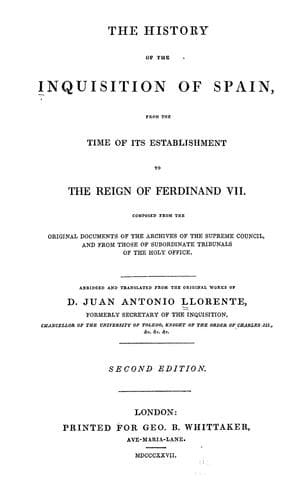
The History of the Inquisition of Spain from the Time of its Establishment to the Reign of Ferdinand VII.Llorente, Juan Antonio
History
The History of the Inquisition of Spain from the Time of its Establishment to the Reign of Ferdinand VII.
Llorente, Juan Antonio
Inquisition -- Spain
I find, among the other victims at Seville, Don Juan Ponce de Leon,
youngest son to the Count de Baylen; he was cousin-german to the Duke
d'Arcos, and related to the Duchess de Bejar, who were both present at
his _auto-da-fé_. He was condemned as an impenitent Lutheran: he at
first denied the charges, but confessed during the torture: the
inquisitors sent a priest, with whom he was well acquainted, to persuade
him that it would be to his advantage if he confessed the truth. Ponce
was deceived, and made the confession they required; but on discovering
his mistake, the day before the _auto-da-fé_, he made one truly
Lutheran, and treated the priest who attended him with contempt.
Gonzalez de Montes pretends that he persisted in his sentiments, but he
is mistaken, for Ponce confessed when he was fastened to the stake, and
strangled before he was burnt.
Don Juan Gonzalez, a priest of Seville, and a celebrated preacher of
Andalusia, embraced Mahometanism at twelve years of age, because his
parents were Moors, but he was reconciled by the Inquisition. Some time
after he was imprisoned as a Lutheran, but obstinately persisted in
refusing to confess, even when tortured; affirming that his opinions
were founded on the Holy Scriptures, and that, consequently, he could
not be a heretic. This example was imitated by his two sisters, who
suffered in the same _auto-da-fé_: When the gags were taken from their
mouths, Don Juan told them to sing the 106th psalm. They died (say the
Protestants) in the faith of Jesus Christ, and detesting the errors of
the _Papists_.
Brother Garcia de Arias (surnamed the _White Doctor_, on account of the
extreme whiteness of his hair) was a Jeronimite of the Convent of St.
Isidore, at Seville; he was condemned as an impenitent Lutheran, and
perished in the flames. He had professed the doctrines of Luther for
several years, but his sentiments were known only to the principal
partisans of the heresy, such as Vargas, Egidius, and Constantine: his
prudence was so great, that he was looked upon as an orthodox theologian
and of the greatest piety: he even carried his dissimulation so far as
to profess to be an enemy to the Lutherans. He was several times
employed to qualify heretical propositions, and appeared to be so
devoted to the inquisitorial system, that though he was denounced
several times, the inquisitors declared that the informers acted out of
hatred to him. However, the informations were communicated to him, that
he might be more cautious in his conversations with suspicious persons.
Public-domain text, read in full here on John Shaqi.
Reviews
Reviews
No reviews yet
Be the first to share your thoughts on this work.
Elsewhere in the archive
Join the Discussion
Join the discussion
Sign in to leave a comment or review.
Sign InorCreate an account