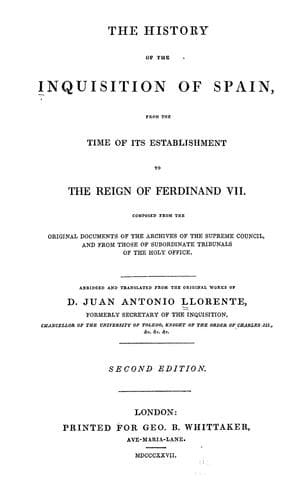
The History of the Inquisition of Spain from the Time of its Establishment to the Reign of Ferdinand VII.Llorente, Juan Antonio
History
The History of the Inquisition of Spain from the Time of its Establishment to the Reign of Ferdinand VII.
Llorente, Juan Antonio
Inquisition -- Spain
Donna Maria de Bohorques, was the natural daughter of Pedro Garcia de
Xerez Bohorques of one of the first families of Seville, and from which
sprung the Marquises de Ruchena, grandees of the first class. She was
not twenty-one years of age when she was arrested as a Lutheran. She had
been instructed by the doctor, Juan Gil (or Egidius), was perfectly
acquainted with the Latin language, and understood Greek; she had many
Lutheran books, and had committed to memory the Gospels, and some of the
principal works which explain the text in a Lutheran sense. She was
conducted to the secret prisons, where she acknowledged her opinions,
and defended them as Catholic. She said that some of the facts and
propositions contained in the depositions were true, but denied the
others, either because she had forgotten them, or was afraid to
compromise others. She was then tortured, and confessed that her sister,
Jane Bohorques, was acquainted with her sentiments, and had not
disapproved them. The fatal consequences of this confession will be
shown hereafter. The definitive sentence was pronounced, and Maria
Bohorques was condemned to _relaxation_. As the sentence was not
communicated to the prisoner till the day before the _auto-da-fé_, the
inquisitors desired that Maria should be exhorted during the interval.
Two Jesuits and two Dominicans were successively sent to her. They
returned full of admiration at the learning of the prisoner, but
displeased at her obstinacy, in explaining the texts of Scripture which
they proposed, in a Lutheran sense. On the day before the _auto-da-fé_,
two other Dominicans went with the first, to make a last effort to
convert Maria, and they were followed by several other theologians of
different religious orders. Maria received them with as much pleasure as
politeness, but she told them, that they might spare themselves the
trouble of speaking to her of their doctrines, as they could not be more
concerned for her salvation than she was herself; that she would
renounce her opinions if she felt the least uncertainty; but that she
was still more convinced that she was right, since so many _popish_
theologians had not been able to advance any arguments, for which she
had not prepared a solid and conclusive answer. At the place of
execution, Don Juan Ponce de Leon, who had abjured heresy, exhorted
Maria to do the same. She received his advice very ill, and called him
_ignorant, an idiot, and a babbler_: she added, that it was no longer a
time to dispute, and that the few moments they had to live ought to be
employed in meditating on the passion and death of their Redeemer, to
reanimate the faith by which they were to be justified and saved.
Although she was so obstinate, several priests, and a great number of
monks, earnestly entreated that she might be spared, in consideration of
her extreme youth and surprising merit, if she would consent to repeat
the _Credo_. The inquisitors granted their request; but scarcely had
Public-domain text, read in full here on John Shaqi.
Reviews
Reviews
No reviews yet
Be the first to share your thoughts on this work.
Elsewhere in the archive
Join the Discussion
Join the discussion
Sign in to leave a comment or review.
Sign InorCreate an account