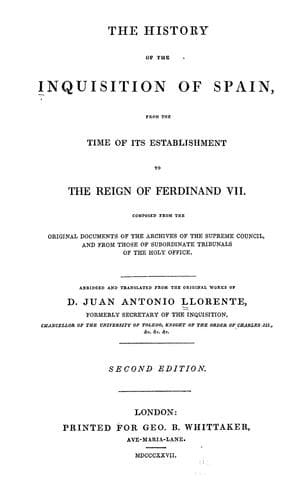
The History of the Inquisition of Spain from the Time of its Establishment to the Reign of Ferdinand VII.Llorente, Juan Antonio
History
The History of the Inquisition of Spain from the Time of its Establishment to the Reign of Ferdinand VII.
Llorente, Juan Antonio
Inquisition -- Spain
Maria finished it, than she began to interpret the articles on the
Catholic faith, and the judgment of the quick and the dead, according to
the opinions of Luther: they did not give her time to conclude; the
executioner strangled her, and she was afterwards burnt. Such is the
true history of Maria Bohorques, according to the writings of the
Inquisition.
Paul IV. died at Rome on the 18th of August, 1559, a few days before the
_auto-da-fé_ at Seville. When the Romans learnt this event, they went in
crowds to the Inquisition, set all the prisoners at liberty, and burnt
the house and the archives of the tribunal. It cost much money and
trouble to prevent the enraged populace from burning the convent _De la
Sapienza_ of the Dominicans, who conducted all the affairs of the Roman
Inquisition. The principal commissioner was wounded, and his house
burnt. The statue of Paul IV. was taken from the capitol and destroyed;
the arms of the house of Carafa were everywhere defaced, and even the
mortal remains of the Pope would have been abused, if the Canons of the
Vatican had not interred him secretly, and if the guards had not
defended the pontifical residence[21]. This revolt of the Romans did not
alarm the inquisitors of Spain, where the people had been brought up by
the monks in different principles from those professed by their
ancestors under the reign of Ferdinand, and the first ten years of that
of Charles V.
_Auto-da-fé of the year 1560._
The inquisitors of Seville, who had perhaps depended on the presence of
Philip II., prepared another _auto-da-fé_ for him similar to that of
Valladolid. When they had lost all hope of that honour, the ceremony was
performed: it took place on the 22nd of December, 1560. Fourteen
individuals were burnt in person (_i. e._ relaxed), and three in effigy;
thirty-four were subjected to penances, and the reconciliation of three
other persons was read before the _auto-da-fé_. The effigies were those
of the Doctors Egidius, Constantine, and Juan Perez.
Public-domain text, read in full here on John Shaqi.
Reviews
Reviews
No reviews yet
Be the first to share your thoughts on this work.
Elsewhere in the archive
Join the Discussion
Join the discussion
Sign in to leave a comment or review.
Sign InorCreate an account