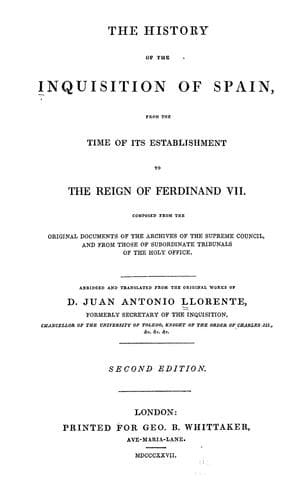
The History of the Inquisition of Spain from the Time of its Establishment to the Reign of Ferdinand VII.Llorente, Juan Antonio
History
The History of the Inquisition of Spain from the Time of its Establishment to the Reign of Ferdinand VII.
Llorente, Juan Antonio
Inquisition -- Spain
49th. When it is necessary to decree the torture, the accused shall be
informed of the motives for employing it, and the offences for which he
is to suffer it; but after it has been decided he shall not be examined
on any particular fact, he shall be allowed to say what he pleases.
Experience has shown that if he is questioned on any subject when pain
has reduced him to the last extremity, he will say anything that is
required of him, which may be injurious to other persons, in making them
parties concerned, and producing other inconveniences.
50th. The question shall not be decreed until the process is terminated,
and the defence of the accused has been heard. As the sentence of
recourse to the question admits of an appeal, the inquisitors shall
consult the council, if the case is doubtful; if the accused can
maintain his appeal, it shall be admitted. But if the point of law is
clear, the inquisitors are not required to consult the council, or to
admit the application of the accused; they are at liberty to proceed
immediately to execution, as if it had not been made.
51st. If the inquisitors think that the appeal ought to be admitted,
they shall send the writings of the process to the Supreme Council,
without informing the parties, or any individual not belonging to the
tribunal, because the council will send an order to the inquisitors, if
it is considered proper that they should be made acquainted with it.
52nd. If an inquisitor is challenged, and there is another in the
tribunal, the first shall abstain from performing his office, and the
second shall take his place, after the council has been informed of the
circumstance. If there is only one inquisitor in the tribunal, the
proceedings shall be suspended until the decision of the Supreme Council
has been received; the same course shall be pursued if there are several
inquisitors, and they are all challenged.
53rd. Twenty-four hours after the accused has been put to the question,
he shall be asked if he persists in his declarations, and if he will
ratify them. The notary of the tribunal shall appoint the time for this
formality, and likewise that for the application of the question. If at
this moment the accused confesses his crimes, and afterwards ratifies
his declarations in such a manner that the inquisitors may believe him
to be converted, repentant, and sincere in his confessions, he may be
admitted to reconciliation, notwithstanding the article in the ordinance
of Seville, in 1484. If the accused retracts his declaration, the
inquisitors shall proceed according to rule.
Public-domain text, read in full here on John Shaqi.
Reviews
Reviews
No reviews yet
Be the first to share your thoughts on this work.
Elsewhere in the archive
Join the Discussion
Join the discussion
Sign in to leave a comment or review.
Sign InorCreate an account