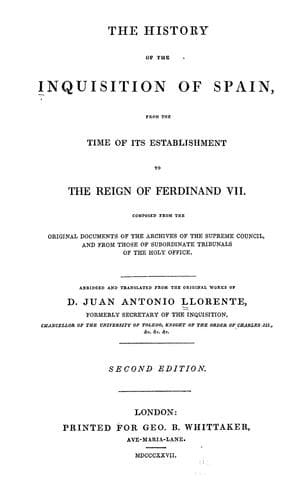
The History of the Inquisition of Spain from the Time of its Establishment to the Reign of Ferdinand VII.Llorente, Juan Antonio
History
The History of the Inquisition of Spain from the Time of its Establishment to the Reign of Ferdinand VII.
Llorente, Juan Antonio
Inquisition -- Spain
45th. The inquisitors must maturely consider motives and circumstances
before they decree the torture; and when they have resolved to have
recourse to it, they must state the motive: they must declare if the
torture is to be employed _in caput proprium_, because the accused is
subjected to it as persisting in his denials, and incompletely convicted
in his own trial; or if he suffers it _in caput alienum_, as a witness
who denies, in the trial of another accused, the facts of which he has
been a joint witness. If he is convicted of bad faith in his own cause,
and is consequently liable to be _relaxed_, or if he is equally so in
any other affair, he may be tortured, though he must be given up to the
secular judge for what concerns him personally. If he does not reveal
anything in being tortured as a witness, he shall nevertheless be
condemned as an accused; but if the question forces him to confess his
crime, and that of another person, and he solicits the indulgence of his
judges, the inquisitors shall conform to the rules of right.
46th. If only a semi-proof of the crime exists, or if appearances will
not admit of the acquittal of the prisoner, he shall make an abjuration
as being either _violently_ or _slightly_ suspected. As this measure is
not a punishment for the past, but a precaution for the future,
pecuniary penalties shall be imposed; but he shall be informed that if
he again commits the crime for which he was denounced, he will be
considered as having _relapsed_, and be delivered over to the secular
judge: for this purpose he shall sign his act of abjuration.
47th. In cases where only the semi-proof, or some indications of a crime
exist, the accused has been sometimes permitted to clear himself
canonically before the number of persons appointed in the ancient
instructions; the inquisitors, the ordinary, and the consultors, may
therefore allow it if they think proper, but they must observe that this
proceeding is very dangerous, not often used, and can only be employed
with great caution[30].
48th. The third manner of proceeding in this case is to employ the
_question_. This measure is thought to be dangerous and not certain,
because its effects depend upon the physical strength of the subject;
consequently no rule can be prescribed on this point, but it is left to
the prudence and equity of the judges. Nevertheless the question shall
only be decreed by the ordinary, the consultors, and the inquisitors, or
applied without their concurrence, as circumstances may occur, when
their presence would be necessary[31].
Public-domain text, read in full here on John Shaqi.
Reviews
Reviews
No reviews yet
Be the first to share your thoughts on this work.
Elsewhere in the archive
Join the Discussion
Join the discussion
Sign in to leave a comment or review.
Sign InorCreate an account