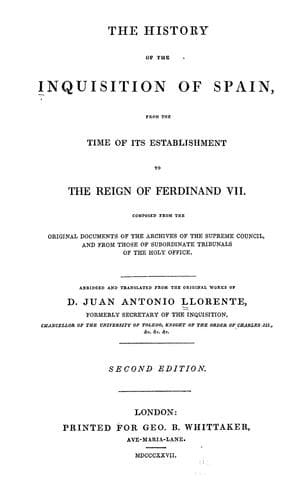
The History of the Inquisition of Spain from the Time of its Establishment to the Reign of Ferdinand VII.Llorente, Juan Antonio
History
The History of the Inquisition of Spain from the Time of its Establishment to the Reign of Ferdinand VII.
Llorente, Juan Antonio
Inquisition -- Spain
59th. If a prisoner dies before his trial is terminated, and his
declarations have not extenuated the charges of the witnesses, so as to
give a sufficient cause for reconciliation, the inquisitors shall give
notice of his death to his children, his heirs, or other persons who
have the right of defending his memory and property; and, if there is
cause to pursue the trial of the deceased, a copy of the depositions and
the act of accusation shall be remitted to them, and all that they
advance in defence of the accused shall be received.
60th. If the mind of an accused person becomes deranged before the
conclusion of the trial, a guardian or defender shall be appointed for
him; if the children or relations of the accused present any means of
defence in his favour to the tribunal, when he is in possession of his
senses, the inquisitors shall not permit them to be joined to the other
writings of the process, because neither the children nor relations of
the accused are lawful parties; yet in a distinct and separate writing
they may decree what they think fit, and take measures to discover the
truth, without communicating with the prisoner, or the persons who
represent him.
61st. When sufficient proof exists to authorize proceedings against the
memory and property of a deceased person, according to the _ancient
instruction_, the accusation of the fiscal shall be signified to the
children, the heirs, or other interested persons, each of whom shall
receive a copy of the notification. If no person presents himself to
defend the memory of the accused, or to appeal against the seizure of
his goods, the inquisitors shall appoint a defender, and pursue the
trial, considering him as a party. If any one interested in the affair
appears, his rights shall be admitted, although he should be a prisoner
in the holy office at the time; but he shall be obliged to choose a free
person to act for him. Until the affair is terminated, the sequestration
of the property cannot take place, because it has passed into other
hands: yet the possessors shall be deprived of it, if the deceased is
found guilty.
62nd. If a person is found not liable to prosecution, this resolution of
the tribunal shall be announced in the _auto-da-fé_ by a public act, in
any manner most suitable to the interested party; the errors with which
he was charged shall not be designated, if the accusation is not
proved. If a deceased person is pronounced free from prosecution, the
judgment shall be formally published, because the action was public and
notorious.
Public-domain text, read in full here on John Shaqi.
Reviews
Reviews
No reviews yet
Be the first to share your thoughts on this work.
Elsewhere in the archive
Join the Discussion
Join the discussion
Sign in to leave a comment or review.
Sign InorCreate an account