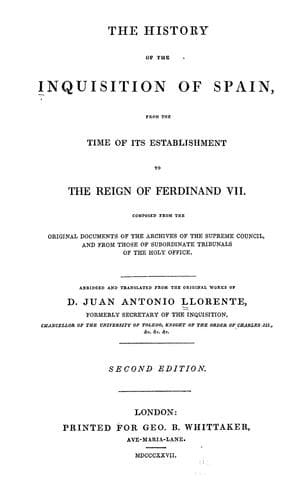
The History of the Inquisition of Spain from the Time of its Establishment to the Reign of Ferdinand VII.Llorente, Juan Antonio
History
The History of the Inquisition of Spain from the Time of its Establishment to the Reign of Ferdinand VII.
Llorente, Juan Antonio
Inquisition -- Spain
63rd. When a defender is appointed for the memory of a person accused
after his death, in default of interested persons to take his defence,
the choice must only fall on a person not belonging to the Inquisition;
but he must be required to keep all the proceedings secret, and not to
communicate the _depositions_ and the accusations to any but the lawyers
of the prisoners, unless a decision of the inquisitors authorize him to
make them known to other persons.
64th. When absent individuals are to be tried, they shall be summoned to
appear, by three public acts of citation at different intervals,
according to the known or supposed place of their residence. The fiscal
shall denounce them contumacious, at the end of each citation.
65th. The inquisitors may take cognizance of several crimes which
occasion suspicion of heresy, although they do not consider the accused
an heretic, on account of certain circumstances; such as bigamy,
blasphemy, and suspicious propositions. In these cases the application
of the punishments depends upon the prudence of the judges, who ought to
follow the rules of right, and consider the gravity of the offence.
However, if they condemn the accused to corporeal punishment, such as
whipping, or the galleys, they shall not say that it may be commuted for
pecuniary penalties; for this measure would be an extortion, and an
infringement of the respect due to the tribunal.
66th. If the inquisitors and the ordinary differ in opinion when they
assemble to give their votes on the definitive sentence, the trial shall
be referred to the Supreme Council; but if the division is produced by
the manner in which the consultors have voted, the inquisitors may pass
them over, (although they may be more numerous,) and establish the
definitive sentence on their own votes, and that of the ordinary, unless
the importance of the case compels them to apply to the council, even if
the inquisitors, the consultors, and ordinary are unanimous[32].
67th. The _secret notaries_ shall draw up as many literal and certified
copies of the declarations of the witnesses, and the confessions of the
accused, as there are persons designated as guilty, or suspected of the
crime of heresy, that there may be a separate proceeding against each;
for the writings which contain the original charges are not sufficient,
since experience has shown that it always causes confusion, and the
prescribed method has been employed several times, although it increases
the labour of the notaries.
Public-domain text, read in full here on John Shaqi.
Reviews
Reviews
No reviews yet
Be the first to share your thoughts on this work.
Elsewhere in the archive
Join the Discussion
Join the discussion
Sign in to leave a comment or review.
Sign InorCreate an account