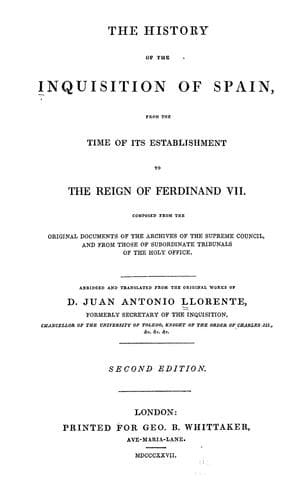
The History of the Inquisition of Spain from the Time of its Establishment to the Reign of Ferdinand VII.Llorente, Juan Antonio
History
The History of the Inquisition of Spain from the Time of its Establishment to the Reign of Ferdinand VII.
Llorente, Juan Antonio
Inquisition -- Spain
I shall only add, that Don Ferdinand Valdés was, in 1566, succeeded by
Don Diego Espinosa, Bishop of Siguenza and President of the Council of
Castile. Espinosa died on the 5th of September, 1572. Don Pedro Ponce de
Leon, Bishop of Placentia and Estremadura, was the next
inquisitor-general, but he died before he had entered on his office.
The king appointed the Cardinal Gaspard de Quiroga, Archbishop of
Toledo, to be the eleventh inquisitor-general: he died on the 20th
November, 1594.
Don Jerome Manrique de Lara succeeded Quiroga; he was Bishop of Avila,
and the son of Cardinal Manrique, who had filled the same office under
Charles V.
Don Jerome died in September, 1595, and after him Don Pedro
Portocarrero, Bishop of Cordova, was at the head of the Inquisition.
The fourteenth inquisitor-general was the Cardinal Don Ferdinand Niño de
Guevara, Archbishop of Seville, who took possession in December 1599,
during the reign of Philip III.
It was under Philip II. that the Inquisition committed the greatest
cruelties; and the reign of this prince is the most remarkable period of
the history of the holy office.
CHAPTER XXIII.
OF SOME AUTOS-DA-FE CELEBRATED IN MURCIA.
The opinions of Luther, Calvin, and the other Protestant reformers, were
not disseminated in the other cities in Spain with the same rapidity as
at Seville and Valladolid; but there is reason to believe that all Spain
would soon have been infected with the heresy, but for the extreme
severity shown towards the Lutherans. From 1560 to 1570 at least one
_auto-da-fé_ was celebrated every year in every Inquisition of the
kingdom, and some heretics of the new sect always appeared among the
condemned persons. Yet the progress of Lutheranism cannot be compared to
that of Judaism and Mahometanism, because these religions had been long
established, and the ancestors of a great number of Spanish families had
professed them. An opinion may be formed of what passed in the other
tribunals from some notices of the proceedings of that of Murcia.
On the 7th of June, 1557, a solemn _auto-da-fé_ was celebrated at
Murcia, where eleven individuals were burnt, and forty-three were
reconciled. On the 12th of February, 1559, thirty victims were burnt
with five effigies, and forty-three were reconciled. On the 14th
February, in the same year, 1560, fourteen persons were burnt, and
twenty effigies: twenty-nine persons were subjected to penances.
On the 8th of September, in the same year, sixteen individuals perished
in the flames, and forty-eight were condemned to penances.
Public-domain text, read in full here on John Shaqi.
Reviews
Reviews
No reviews yet
Be the first to share your thoughts on this work.
Elsewhere in the archive
Join the Discussion
Join the discussion
Sign in to leave a comment or review.
Sign InorCreate an account