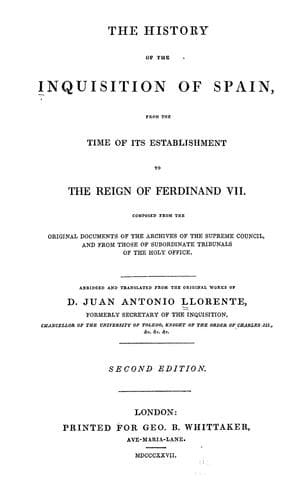
The History of the Inquisition of Spain from the Time of its Establishment to the Reign of Ferdinand VII.Llorente, Juan Antonio
History
The History of the Inquisition of Spain from the Time of its Establishment to the Reign of Ferdinand VII.
Llorente, Juan Antonio
Inquisition -- Spain
When the visitor was gone, the inquisitors recommenced their
prosecution; the fiscal accused Francis Guillen of the crime of
_revocation_, saying that he had imposed on them from fear, ignorance,
or some other motive. When Francis again found himself in danger, he, as
might have been expected, declared that his first depositions were true,
and that the cause of his retracting was a mental indisposition, with
which he had been affected. On the 10th November, 1565, Francis was
condemned to appear in the _auto-da-fé_, to receive three hundred
stripes, and to pass the rest of his life in a prison. The punishment of
imprisonment was commuted for that of serving in the galleys, as long as
the strength and health of Francis allowed of it. The judges reserved
the right of deciding this point themselves. The prisoner was conducted
to the _auto-da-fé_ on the 9th of December, and suffered the punishment
of whipping; he was then transferred to the common royal prison.
After he arrived there, he wrote to his judges, declaring himself
incapable of serving in the galleys. The tribunal revised the judgment,
and sent him to the house of _Mercy_. This proceeding displeased the
fiscal, who protested against it, saying, that the office of the judges
did not extend beyond the sentence, and that they had not the right of
commuting the punishment, without the consent of the
inquisitor-general; the affair stopped here, and Francis had been
sufficiently punished for his indiscretion to render him more cautious
for the future.
The irregularity and disorder of the proceedings of this tribunal may be
seen still more clearly in another trial before the Inquisition of
Murcia, about the same time, and which was undertaken in consequence of
the depositions of Guillen. It was instituted against _Melchior
Hernandez_, a merchant of Toledo, which place he afterwards left to
establish himself at Murcia. As he was descended from the Jews, he was
suspected of being attached to the religion of his ancestors. After
being taken to the secret prisons from the informations of seven
witnesses, he had his first audience of _admonition_ on the 5th of June,
1564; he was accused of having frequented a clandestine synagogue in
Murcia, from 1551 to 1557, when the assembly was discovered; and of
having acted and discoursed in a manner that proved his apostasy. Two
witnesses afterwards appeared, and the accused having denied all the
charges, the publication of the nine deponents was given to him: he
persisted in his denial, and by the advice of his defender, alleged that
the evidence of the witnesses could not be admitted, as they
contradicted each other, and several of them were known to be his
enemies.
To prove this, and to challenge some other persons, he presented a
memorial which was admitted, although it was afterwards considered to
have failed in disproving the charges.
Public-domain text, read in full here on John Shaqi.
Reviews
Reviews
No reviews yet
Be the first to share your thoughts on this work.
Elsewhere in the archive
Join the Discussion
Join the discussion
Sign in to leave a comment or review.
Sign InorCreate an account