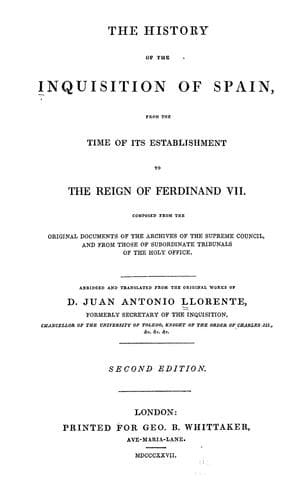
The History of the Inquisition of Spain from the Time of its Establishment to the Reign of Ferdinand VII.Llorente, Juan Antonio
History
The History of the Inquisition of Spain from the Time of its Establishment to the Reign of Ferdinand VII.
Llorente, Juan Antonio
Inquisition -- Spain
Some days after the inquisitor-general caused the tribunal to be
visited; the visitor declared that the judges had acted contrary to the
laws in conducting Francis to the _auto-da-fé_ in the habit of a relaxed
person, when they had decided on his reconciliation. The inquisitors
endeavoured to justify themselves by saying that they thought it would
frighten the accused into making new declarations. The visitor
commanded that Francis should be reconciled and taken to the prison of
the _Penitents_, likewise called that of _Mercy_.
Francis, who was probably a little deranged, declared several times that
he had deceived the inquisitors by accusing some persons as heretics who
were innocent, because he hoped that he should escape death by this
proceeding. These words were reported to the inquisitors, and Francis
was taken to the secret prisons. There was an act of accusation against
him; he acknowledged all the articles of the fiscal, and affirmed upon
oath that all his declarations were true; he ratified them, and begged
that he might be pardoned. On the 19th of January, 1564, he was
condemned to appear in the _auto-da-fé_ with the gag, to receive two
hundred stripes, and to pass three years in the house of _Penitence_.
Francis suffered the stripes, but they did not render him more prudent,
for he declared, even in the prison, that he was unjustly treated, for
all that he had said was false, and dictated by fear.
In 1565, the Inquisition of Murcia received the visit of a new
commissary, who obliged Francis to appear before him as a witness, to
ratify a declaration which he had made against Catherine Perez, his
wife, for Judaism. The following dialogue took place between the visitor
and the witness:--
Do you remember making a declaration against Catherine Perez, your
wife?--Yes.
What was that declaration?--It will be found in the writings of the
trial. (The declaration was here read to Francis.)
Is what you have just heard true?--No.
Why then did you affirm that it was so?--Because I heard an inquisitor
say it.
Are the declarations against other persons true?--No.
Why did you make them?--Because I perceived in the _auto-da-fé_ at which
I assisted, that the contents were read in the publication of the
depositions, and I thought that if I declared it to be true, I should
avoid death as being a good penitent.
Why did you make your ratification after the _auto-da-fé_, when the
fiscal presented you as a witness against your wife, and other
persons?--For the same reason.
After this conversation, Francis was sent back to the prison, where he
wrote a kind of memorial, in which he said that none of the witnesses
were admissible against him, because they differed and contradicted each
other in their declarations.
Public-domain text, read in full here on John Shaqi.
Reviews
Reviews
No reviews yet
Be the first to share your thoughts on this work.
Elsewhere in the archive
Join the Discussion
Join the discussion
Sign in to leave a comment or review.
Sign InorCreate an account