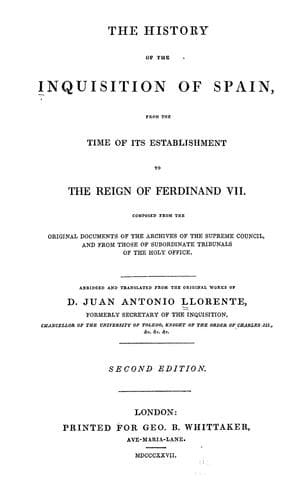
The History of the Inquisition of Spain from the Time of its Establishment to the Reign of Ferdinand VII.Llorente, Juan Antonio
History
The History of the Inquisition of Spain from the Time of its Establishment to the Reign of Ferdinand VII.
Llorente, Juan Antonio
Inquisition -- Spain
"But how is it that what you have confessed of yourself, and many other
things which you now deny, are the result of the depositions of a great
many witnesses?"--"I do not know if that is true or false, for I have
not seen the writings of the trial; but if the witnesses have said that
which is imputed to them, it is because they were placed in the same
situation as I am. They do not love me better than I love myself; and I
have certainly declared against myself both truth and falsehood."
"What motive had you for declaring things injurious to yourself, if they
were false?"--"I did not think it would be injurious to me; on the
contrary, I expected to derive great advantages from it, because I saw
that if I did not confess anything, I should be considered as
impenitent, and the truth would lead me to the scaffold. I thought that
falsehood would be most useful to me, and I found it so in two
_autos-da-fé_."
On the 6th of June Melchior Hernandez was informed that he must prepare
for death on the following day. He was clothed in the habit of the
persons condemned to be burnt, and a confessor was appointed for him. At
two o'clock in the morning he demanded an audience, saying that he
wished to acquit his conscience. An inquisitor, attended by a secretary,
went to his cell; Melchior then declared "that, at the point of
appearing before the tribunal of the Almighty, and without any hope of
escaping from death by new delays, he thought himself bound to declare
that he had never conversed with any person on the Mosaical Law; that
all he had said on this subject was founded on the wish to preserve
life, and the belief that his confessions were pleasing to the
inquisitors; that he asked pardon of the persons implicated, that God
might pardon him, and that no injury might be done to their honour and
reputation."
The inquisitor represented that he ought not to speak falsely, even from
a motive of compassion for the denounced persons; that the declarations
of the witnesses had every appearance of truth, and he therefore
entreated him, in the name of God, not to increase his sins at the hour
of death. Melchior merely repeated that all his former declarations were
false. The royal judge condemned him to be strangled, and his body was
afterwards burnt.
Some doubts may be entertained of the sincerity of the last declarations
of Melchior Hernandez, but the extreme irregularity of the proceedings
of the tribunal must be evident to every one. The intervention of the
Supreme Council proves that the same system was pursued in the other
tribunals, since it approved of their proceedings, and exercised the
rights of revocation and censure.
Public-domain text, read in full here on John Shaqi.
Reviews
Reviews
No reviews yet
Be the first to share your thoughts on this work.
Elsewhere in the archive
Join the Discussion
Join the discussion
Sign in to leave a comment or review.
Sign InorCreate an account