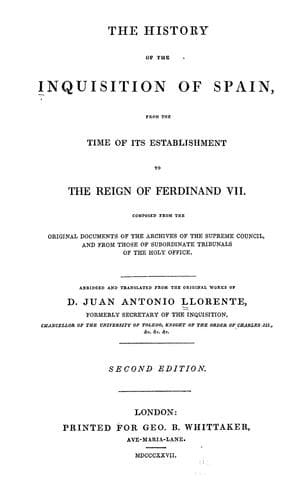
The History of the Inquisition of Spain from the Time of its Establishment to the Reign of Ferdinand VII.Llorente, Juan Antonio
History
The History of the Inquisition of Spain from the Time of its Establishment to the Reign of Ferdinand VII.
Llorente, Juan Antonio
Inquisition -- Spain
In 1564 another _auto-da-fé_ took place at Murcia, one person and eleven
effigies were burnt; there were also forty-eight penitents, but the
following circumstance was the cause of this ceremony being more
particularly remembered. Pedro Hernandez had been reconciled in 1561, as
suspected of Judaism. In 1564 he fell sick, and through the mediation of
his confessor demanded an audience of the inquisitors. One of them went
to his house, and Pedro told him that he had denied the crime of which
he was accused, and had afterwards made a confession, alleging as an
excuse for this conduct, that a French priest had given him absolution.
He now confessed that this was not true, and that he wished to relieve
his conscience by acknowledging it before he died. The inquisitors
presented this declaration to the tribunal, which immediately caused
Pedro to be taken from his bed and conveyed to their prisons, where he
died three days after.
Three other _autos-da-fé_ took place at Murcia in the years 1565, 1567,
and 1568, in which thirty-five persons were burnt, and a considerable
number condemned to penances.
CHAPTER XXIV.
OF THE AUTOS-DA-FE CELEBRATED BY THE INQUISITIONS OF TOLEDO, SARAGOSSA,
VALENCIA, LOGRONO, GRENADA, CUENCA, AND SARDINIA, DURING THE REIGN OF
PHILIP II.
_Inquisition of Toledo._
On the 25th of February, 1560, the inquisitors of Toledo celebrated an
_auto-da-fé_, in which several persons were burnt, with some effigies,
and a great number subjected to penances. This _auto-da-fé_ was
performed to entertain the new queen, Elizabeth de Valois, the daughter
of Henry II., King of France. It is rather surprising that this
melancholy ceremony was chosen to amuse a royal princess of thirteen
years of age, and who in her native country had been accustomed to
brilliant festivals, suitable to her rank and age. The Cortes general of
the kingdoms was also assembled at Toledo at the same time, to swear
allegiance to the heir-presumptive, Don Carlos, so that this
_auto-da-fé_, with the exception of the number of victims, was as solemn
as any of those in Valladolid.
In 1561, another _auto-da-fé_ took place in the same town; four
impenitent Lutherans were burnt, and eighteen reconciled. Among those
condemned to penances was one of the king's pages, a native of Brussels,
named Don _Charles Estrect_, but the young queen Elizabeth obtained his
pardon.
On the 17th of June, 1565 (which was Trinity Sunday), an _auto-da-fé_ of
forty-five persons was celebrated; eleven were burnt, and thirty-four
condemned to penances. Some of these were Lutherans, but the greater
number were Jews. Among those designated as Protestants, some were
called _Lutherans_, others the _Faithful_; there was a third called
_Huguenaos_, after _Huguenots_.
Public-domain text, read in full here on John Shaqi.
Reviews
Reviews
No reviews yet
Be the first to share your thoughts on this work.
Elsewhere in the archive
Join the Discussion
Join the discussion
Sign in to leave a comment or review.
Sign InorCreate an account