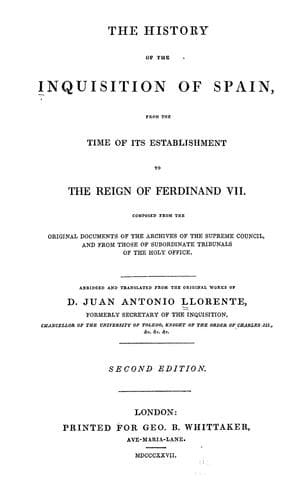
The History of the Inquisition of Spain from the Time of its Establishment to the Reign of Ferdinand VII.Llorente, Juan Antonio
History
The History of the Inquisition of Spain from the Time of its Establishment to the Reign of Ferdinand VII.
Llorente, Juan Antonio
Inquisition -- Spain
_Berroçosa_ (Fray Manuel Santos), author of a work called _Essays on the
Theatre of Rome_. He was imprisoned by the Inquisition of Toledo,
because he spoke of the court of Rome, in his Essays, in a manner
displeasing to the Jesuits and inquisitors. The proceedings in this
trial were so arbitrary, that the work in question was not examined
until the affair was nearly finished. The writings of this trial were
taken from the archives of the Inquisition, for some unknown reason. In
1768 they were laid, by the king's order, before the council
extraordinary of bishops, who were assembled to consider the affairs of
the Jesuits.
_Blanco_ (Don Francis), archbishop of Santiago. See Chapter 29.
_Brozas_ (Francis Sanchez de Las), generally called _el Brocense_; he
was born in the village of Las Brozas, from whence he took his name. He
was one of the greatest _humanists_ of his age, and the most
distinguished Spaniard of that party in the time of Philip II. During
this reign he published several works, which are mentioned by Nicolas
Antonio in his catalogue. The severe _Justus Lipse_ calls him the
_Mercury and Apollo of Spain_, and Gaspard Scioppius, the _divine man_.
He was prosecuted by the Inquisition of Valladolid several times for
some propositions contained in his works, but principally in a book in
octavo, entitled, _Escolias à las quatro Sylvas escritas en verso
heroico por Angelo Policiano, intituladas Nutricia, Rustico, Manto y
Ambra_; viz. "Commentaries on the four Sylvas, written in heroic verse
by Angelo Politiano, called _Nutricia_, _Rustico_, _Manto_, and
_Ambra_." _El Brocense_ completely satisfied the qualifiers, and his
work was not inscribed on the Index.
_Baruaga_ (Don Thomas Saenz), archbishop of Saragossa. See Chapter 29.
_Cadena_ (Louis de la), second chancellor of the university of Alcala de
Henares, and nephew of Doctor Pedro de Lerma, who was the first who
possessed that dignity. Cadena was one of the most learned men of his
time; he understood Hebrew, Greek, Arabic, and other eastern languages;
he wrote Latin with the greatest elegance, and enjoyed a high reputation
among the literati. The learned Alvaro Gomez de Castro says, in his
_History of Cardinal Ximenez de Cisneros_, that he had formed the design
of destroying the bad scholastic taste which reigned in the
universities. This enterprise cost Cadena dear: those who were attached
to the opinions of the schools denounced him to the Inquisition of
Toledo, as suspected of Lutheranism; the archbishops Ximenez de Cisneros
and Fonseca, who protected the persecuted members of the university of
Alcala, were no more; and Cadena was obliged to follow the example of
his uncle, and fly to Paris to escape the dungeons of the holy office.
He was received as a doctor in the Sorbonne, and died a professor in
that celebrated house.
_Campomanes._ See following Chapter.
_Cano_ (Melchior), bishop of Canary. See Chapter 29.
Public-domain text, read in full here on John Shaqi.
Reviews
Reviews
No reviews yet
Be the first to share your thoughts on this work.
Elsewhere in the archive
Join the Discussion
Join the discussion
Sign in to leave a comment or review.
Sign InorCreate an account