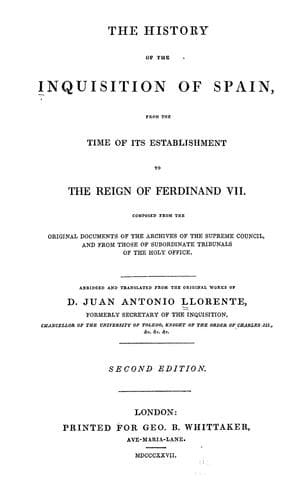
The History of the Inquisition of Spain from the Time of its Establishment to the Reign of Ferdinand VII.Llorente, Juan Antonio
History
The History of the Inquisition of Spain from the Time of its Establishment to the Reign of Ferdinand VII.
Llorente, Juan Antonio
Inquisition -- Spain
subjected to several other penances, one of which was being obliged to
confess to a priest, who was appointed three times in the year,--at
Christmas, Easter, and Pentecost.
_Balza_ (Francis), Franciscan, and a celebrated preacher in the reign of
Charles III. When the Jesuits were driven from Spain, he openly preached
against the relaxed morals of the age; he inveighed against the authors
who had introduced and propagated them, and endeavoured to inspire
people with a horror of reading their works. As some of these authors
were Jesuits, he declaimed violently against those persons who blamed
the king for the measures he had taken, to drive them out of the
kingdom. Balza was denounced at Logroño, and the inquisitors gave him to
understand, that he would be treated with severity if he did not change
his tone.
_Barriovero_ (Doctor Ferdinand de), theologist of the church of Toledo,
and a professor in the university. He was tried in 1558, for approving
the doctrine of the Catechism of Don Bartholomew Carranza. He allayed
the storm by retracting, when he received the king's order to do so, and
by sending his recantation to the Pope, when the Archbishops of Granada
and Santiago, and the Bishop of Jaen adopted that measure.
_Belando_ (Fray Nicolas de Jesus), Franciscan: he was prosecuted on
account of his _Civil History of Spain_. In this work he gives an
account of all the events from the accession of Philip IV. to 1733. The
inquisitors prohibited this book entirely from political motives, and
not from anything relating to doctrine; their judgment against Belando
was given on the 6th of December, 1774. The inquisitors had no respect
either for the license at the beginning of the book, the dedication to
Philip V., or for the favourable opinion of an enlightened member of the
Council of Castile, who was commissioned by his majesty to examine it,
before he allowed it to be dedicated to him. The author appealed against
the sentence, and demanded to be heard: he offered to reply to all the
observations, and to make any alterations or suppressions in his work
which the tribunal should suggest. This attempt of Belando to defend his
book was considered as a crime, and he was confined in the dungeons of
the holy office, where he suffered the harshest treatment. He only left
them to be imprisoned for life in a convent, and he was prohibited from
ever composing another work. He was stripped of the honours which
distinguished him in his order, and more severe penances were inflicted
on him than if he had been an heretic.
_Bercial_ (Clement Sanchez del), priest, archdeacon of Valderas, and
dignitary of the church of Leon. He was prosecuted and punished in the
time of Charles V. for Lutheranism. He was condemned for some
propositions in a work called _Sacramental_. In 1559, the
inquisitor-general Valdez placed this book in the _Index_.
Public-domain text, read in full here on John Shaqi.
Reviews
Reviews
No reviews yet
Be the first to share your thoughts on this work.
Elsewhere in the archive
Join the Discussion
Join the discussion
Sign in to leave a comment or review.
Sign InorCreate an account