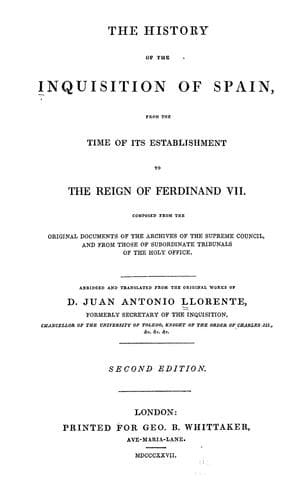
The History of the Inquisition of Spain from the Time of its Establishment to the Reign of Ferdinand VII.Llorente, Juan Antonio
History
The History of the Inquisition of Spain from the Time of its Establishment to the Reign of Ferdinand VII.
Llorente, Juan Antonio
Inquisition -- Spain
_Cuesta_ (Don Jerome de la), penitentiary canon of the cathedral of
Avila. He was arrested for Jansenism, and heresy, while his brother
Antonio was pursued, to whom he furnished the means of flight, at the
expense of his own safety. He passed five years in the prisons of the
Inquisition, and he would have been detained for a much longer time, but
for the solicitations addressed to Charles IV., by persons of the
highest rank, who obtained permission to cause the original writings of
the trial to be laid before his majesty. Don Jerome proved that the
prosecution of himself and his brother originated in the intrigues of
Don Raphael de Muzquiz, bishop of Avila, and formerly confessor to the
queen, and archbishop of Santiago, and of Don Vincent Soto de Valcarce,
bishop of Valladolid. When the depositions of the witnesses were read to
Don Jerome, his great penetration enabled him to recognise them, and he
clearly proved their injustice. The archbishop of Santiago made many
representations to the king against the two brothers, the Inquisitors of
Valladolid, and some members of the Supreme Council; he did not even
spare Don Ramon Joseph de Arce, archbishop of Saragossa, patriarch of
the Indies, and inquisitor-general: he accused them all of partiality in
favour of the two brothers, who were, besides, countrymen of the chief
of the holy office. The tribunal of Valladolid pronounced Don Jerome
innocent; the votes were divided in the council: the king then examined
the writings, and declared, that, from the reports he had received, the
two brothers were innocent of the crimes of which they were accused. He
authorized Don Antonio to return to Spain, created him and his brother
knights of the order of Charles III., and commanded the
inquisitor-general to appoint them honorary inquisitors. Don Francisco
de Salazar, bishop of Avila, (who in quality of Inquisitor of
Valladolid, and member of the council, had taken a great part in this
intrigue,) received an order from his majesty to reinstate the brothers
in their stalls. This is one of the very rare instances, where the King
of Spain took an active part in the affairs of the Inquisition, and one
of the still more rare occurrences where innocence has triumphed.
_Delgado_ (Don Francis), archbishop of Santiago. See Chapter 29.
Public-domain text, read in full here on John Shaqi.
Reviews
Reviews
No reviews yet
Be the first to share your thoughts on this work.
Elsewhere in the archive
Join the Discussion
Join the discussion
Sign in to leave a comment or review.
Sign InorCreate an account