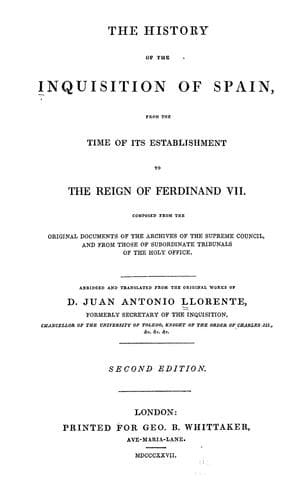
The History of the Inquisition of Spain from the Time of its Establishment to the Reign of Ferdinand VII.Llorente, Juan Antonio
History
The History of the Inquisition of Spain from the Time of its Establishment to the Reign of Ferdinand VII.
Llorente, Juan Antonio
Inquisition -- Spain
_Feyjoo_ (Benedict), Benedictine, born in the Asturias, and a
distinguished literati. He was one of the first who restored good taste
in Spain: the works which he has composed, have been enumerated by Don
Juan Sempere y Guarinos in the _Catalogue of the Authors who flourished
during the Reign of Charles III._ This learned man was denounced at the
different tribunals of the Inquisition, as being suspected of the
different heresies of the fifteenth century, and of that of the ancient
Iconoclasts; most of his accusers were ignorant and prejudicial monks,
of whom he had made enemies by the arguments in his _Critical Theatre_
against false devotion, false miracles, and some superstitious customs.
It was fortunate for the author that the council of the Inquisition was
well acquainted with the purity of his principles and Catholicism.
Although the progress of knowledge has been extremely slow in Spain, it
must be confessed that it has even penetrated into the interior of the
_Holy House_ during the last part of the eighteenth century.
_Fernandes_ (Juan), doctor of theology, prior of the cathedral of
Palencia. He was prosecuted from the declarations of some Lutherans who
were executed in 1559, particularly that of Fray Dominic de Roxas, who
quoted several propositions of Fernandez, in which he pretended to find,
especially on the subject of justification, the same opinions as his
own. The fiscal presented Fray Dominic as a witness in the trial of
Fernandez: he persisted in his declaration (he was already condemned to
_relaxation_, but did not know it), and expected to be reconciled as a
penitent. Fernandez, however, only received a reprimand for not having
observed, in his discourse, the prudence which became a doctor of
theology, at a period when heresy was so common in the kingdom.
_Frago_ (Don Pedro), bishop of Jaca. See Chapter 29.
_Gonzalo_ (Don Vitorian Lopez), bishop of Murcia. _Ibid._
_Gorrionereo_ (Don Antonio), bishop of Almeria. _Ibid._
_Guerrero_ (Don Pedro), archbishop of Grenada. _Ibid._
_Grenada_ (Fray Louis de). _Ibid._
_Gracian_ (Fray Jerome), Carmelite, born at Valladolid, and the son of
Diego Gracian, secretary to Charles V., and Jane Dantisqui, daughter of
the ambassador of Poland, at the court of the emperor. He was a doctor
of theology, and professor of philosophy at the university of Alcala. He
wrote several works of a mystical nature, and some others on literary
subjects, which are mentioned by Nicolas Antonio. He was prior of a
convent of barefooted Carmelites at Seville, which he founded when St.
Theresa and her community, of whom he was the director, were attacked by
the Inquisition. The tribunal of Seville prosecuted him as a heretic, of
the sect of the _Illuminati_; but his trial failed for want of proof.
Father Jerome experienced many vicissitudes; but as they have been
related by historians it is unnecessary to mention them here.
_Gudiel de Peralta_. See the following Chapter.
Public-domain text, read in full here on John Shaqi.
Reviews
Reviews
No reviews yet
Be the first to share your thoughts on this work.
Elsewhere in the archive
Join the Discussion
Join the discussion
Sign in to leave a comment or review.
Sign InorCreate an account