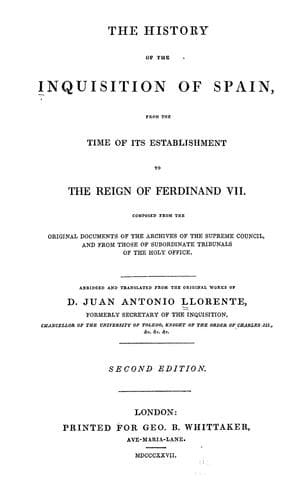
The History of the Inquisition of Spain from the Time of its Establishment to the Reign of Ferdinand VII.Llorente, Juan Antonio
History
The History of the Inquisition of Spain from the Time of its Establishment to the Reign of Ferdinand VII.
Llorente, Juan Antonio
Inquisition -- Spain
_Isla_ (Francis de), Jesuit. He was the author of several works, during
the reign of Charles III.; and also published, under a feigned name, the
_History of the famous Preacher Fray Gerund de Campazas otherwise called
Zotes, written at Madrid in 1750 and 1770, by the Licentiate Don Francis
Lobon de Salazar_. This work is a fine satire, in two volumes, against
the preachers who make a bad use of texts by quoting them in the wrong
place, and distorting their meaning to support an extravagant
proposition. This work produced very beneficial effects in Spain; all
the preachers dreaded the epithet of _Fray Gerund_. This fictitious hero
might be called the Don Quixote of the pulpit, since the effects of this
romance were the same as those of Don Quixote de la Mancha, which was
intended to cure the Spaniards of their ridiculous mania for books of
chivalry. The monks united against this work; they declared it to be
impious, injurious to the ecclesiastical state, and the author suspected
of all the heresies of those who speak with contempt of mendicant
friars. The holy office received an infinite number of denunciations
against this work. The qualifiers were of opinion that it ought to be
prohibited, because the author, in ridiculing those who made a bad use
of the sacred text, had fallen into the same error in composing the
sermons preached by his hero. These volumes were consequently forbidden,
but a publisher at Bayonne reprinted them with a third volume composed
of the different essays which had appeared in Spain, either for or
against the history of Fray Gerund. The true author did not put his
name to the work, but he was known, and the Inquisition having arrested
him, reproached him for what he had done. Isla alleged his laudable
intention of correcting the defects which had been introduced into the
pulpit by bad preachers, and the affair finished there. The Jesuits at
that time had still some power at Madrid, and many of their society were
judges of the holy office.
_Jesus_ (St. Theresa de). See Chapter 27.
_Jovellanos._ See Chapter 43.
_Joven de Salas_ (Don Joseph Ignacio), born in one of the towns of the
Pyrenees, advocate to the king's councils, and a very learned man. He
was chosen by several grandees of Spain to defend the right of their
families to the succession of the elder branches, and for other
interesting trials. He was denounced to the Inquisition for having read
prohibited books: the inquest did not furnish sufficient proof to
authorize imprisonment. His aversion for popular commotions, his love
for social order, the absence of all the royal family, and the
impossibility of resisting the invasion, induced him in 1808 to submit
to the conqueror. The great merit of Joven obtained him the office of a
counsellor of state under King Joseph: for this reason the political
inquisitors who surround the throne of Ferdinand VII. induced him to
banish this respectable old man, who lives at Bordeaux full of years and
virtues.
Public-domain text, read in full here on John Shaqi.
Reviews
Reviews
No reviews yet
Be the first to share your thoughts on this work.
Elsewhere in the archive
Join the Discussion
Join the discussion
Sign in to leave a comment or review.
Sign InorCreate an account