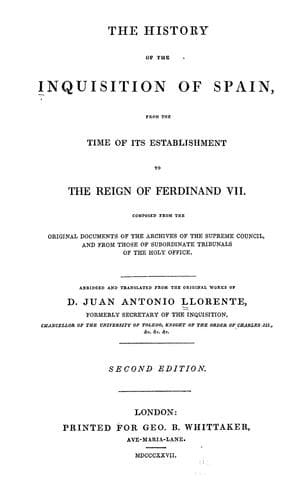
The History of the Inquisition of Spain from the Time of its Establishment to the Reign of Ferdinand VII.Llorente, Juan Antonio
History
The History of the Inquisition of Spain from the Time of its Establishment to the Reign of Ferdinand VII.
Llorente, Juan Antonio
Inquisition -- Spain
_Lainez_ (Diego). See Chapter 29.
_Laplana_ (Don Joseph), bishop of Tarrazona. _Ibid._
_Lara_ (Don Juan Perez de). See the following Chapter.
_Lebrija_ (Antonio de). See Chapter 10.
_Ledesma_ (Fray Juan de), Dominican, professor of theology in the
college of St. Peter Martyr, at Toledo. He was tried by the Inquisition
of Valladolid in 1559, for having expressed a favourable opinion of the
Catechism of Carranza; the proceedings were transferred to the tribunal
of Toledo, which continued the trial without imprisoning Fray Juan, who
was only confined to his college. Fray Juan declared that he had not
perceived the heresies in Carranza's work, for that relying on the
learning, virtue, and zeal of the author, he had read it without
examining it particularly; he added, that as he had not fallen into any
error knowingly, which he acknowledged as such, he abided by the
censures of the qualifiers. He abjured _de levi_; a small private
canonical penance was imposed on him to be performed in secret, and he
received the absolution _ad cautelam_.
_Leon_ (Fray Louis de), an Augustine. He was born in 1527, of Lope de
Belmonte, a judge and member of the chancery of Grenada, and of Donna
Inez de Valera, his wife. He distinguished himself by the purity of his
language and the beauty of his verses, which are looked upon as models
of elegance. He took the monastic habit at Salamanca in 1544. His
discernment was very great, and his knowledge of theology was so
profound, that he was not surpassed by any of his contemporaries, and
had very few rivals. He understood the Greek and Hebrew languages
sufficiently to read them, and wrote Latin with peculiar elegance. He
composed several works in verse and prose, which are mentioned by
Nicolas Antonio. Experience has shown that it is impossible to possess
superior talents without exciting envy; it is not therefore surprising
that he was denounced to the holy office of Valladolid as being
suspected of Lutheranism, at the time that he was professor of theology
at Salamanca. Although he was innocent, he was kept in prison for five
years. The solitude in which he lived during this period was so painful
to him, that he could not help commemorating it in one of his works,
taking for his text the 26th Psalm. Having been acquitted, he resumed
his professorship; but his long captivity, the inaction in which he had
lived, and his grief at being dishonoured, had considerably injured his
health. He however had still sufficient strength to compose, in 1558,
rules for the use of his order. He died at Madrid on the 23rd of August,
1591, during the chapter of which he was named vicar-general.
Public-domain text, read in full here on John Shaqi.
Reviews
Reviews
No reviews yet
Be the first to share your thoughts on this work.
Elsewhere in the archive
Join the Discussion
Join the discussion
Sign in to leave a comment or review.
Sign InorCreate an account