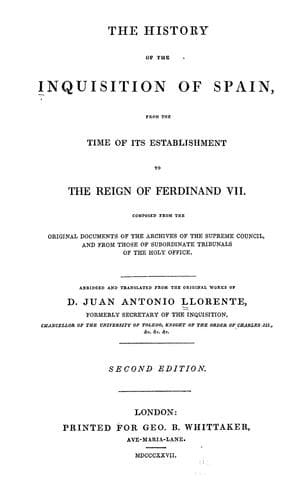
The History of the Inquisition of Spain from the Time of its Establishment to the Reign of Ferdinand VII.Llorente, Juan Antonio
History
The History of the Inquisition of Spain from the Time of its Establishment to the Reign of Ferdinand VII.
Llorente, Juan Antonio
Inquisition -- Spain
_Montijo_ (Donna Maria-Frances Portocarrero, Countess of), a grandee of
Spain: she deserves a distinguished rank among the literati of Spain.
Her claims to celebrity are not only supported by her translation of the
_Christian Instructions on the Sacrament of Marriage_, by M. Le
Tourneux, but by her great love for good literature, and by her efforts
to render the taste for it more common. Her amiable and benevolent
character made her house a favourite resort for many virtuous and
enlightened ecclesiastics: among these may be distinguished Don Antonio
de Palafox, bishop of Cuença, and brother-in-law to the Countess; Don
Antonio de Tabira, bishop of Salamanca; Don Joseph de Jeregui, preceptor
to the Infants of Spain; Don Juan Antonio Rodrigalvarez, archdeacon of
Cuença; Don Juaquin Ivarra, and Don Antonio de Posada, canon of St.
Isidore at Madrid. All these ecclesiastics, and the Countess herself,
were the victims of the calumnies of fanatical priests and monks, who
were the partisans of the Jesuits and of their maxims on discipline and
morals; they were accused of Jansenism. The hatred of their enemies was
so great, that Don Balthazar Calvo, Canon of St. Isidore, and Fray
Antonio de Guerrero, a Dominican, declared in the pulpit, that there
existed in one of the first houses in the capital a conventicle of
Jansenists, protected by a lady of distinction: they took care to speak
of her in such a manner that the person could not be mistaken. The
nuncio of the Court of Rome informed the Pope of all these
circumstances, and his Holiness immediately addressed letters of thanks
to these two preachers and some other individuals, for the zeal they had
shown in defending the faith. These letters were, in a manner, the
signal for a denunciation against all persons suspected of Jansenism,
and did not fail to produce that effect. Besides the suspicion of
Jansenism, the Countess of Montijo was accused of holding a religious
and literary correspondence with Monsignor Henri Gregoire, then bishop
of Blois, and one of the most Catholic and learned men in France, a
Member of the Institute, and author of several works, one of which was a
_Letter to the Inquisitor-general of Spain_, in which he invites him to
propose the suppression of the Inquisition of which he is the head. The
accusers supposed Monsignor Gregoire to be the head of the Jansenists in
France; but they concealed the fact that this bishop had several times
exposed himself to death to give the victims of the revolution the last
spiritual aid, and to maintain the Catholic religion when Robespierre
endeavoured to destroy it. The accusers, who dwelt upon the mention
which had been made of the Countess in the national council of France,
held by the bishops who had taken the oaths, and of which Monsignor
Gregoire was a member. The inquisitors received secret informations of
this affair; but no facts or heretical propositions were proved, and
they had not courage to issue the orders for an arrest.
Public-domain text, read in full here on John Shaqi.
Reviews
Reviews
No reviews yet
Be the first to share your thoughts on this work.
Elsewhere in the archive
Join the Discussion
Join the discussion
Sign in to leave a comment or review.
Sign InorCreate an account