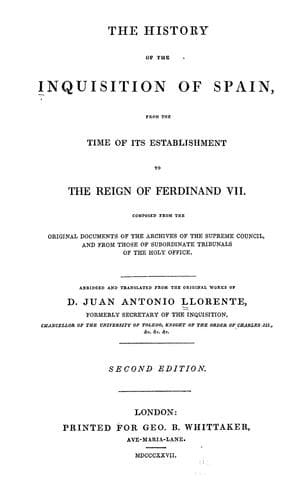
The History of the Inquisition of Spain from the Time of its Establishment to the Reign of Ferdinand VII.Llorente, Juan Antonio
History
The History of the Inquisition of Spain from the Time of its Establishment to the Reign of Ferdinand VII.
Llorente, Juan Antonio
Inquisition -- Spain
The rank and
birth of the accused gave them the means of putting an end to the
persecution: a sort of court intrigue, however, caused the Countess to
be sent from Madrid. She retired to Logroño, where she died in 1808,
with the reputation of being virtuous, and charitable to the poor.
_Mur_ (Don Joseph de). See following Chapter.
_Olavide_ (Don Paul). _Ibid._
_Palafox y Mendoza_ (Don Juan de). See Chapter 30.
_Palafox_ (Don Antonio de), bishop of Cuença. He was prosecuted by the
Inquisition of Madrid on suspicion of Jansenism, but his trial did not
proceed further than the _preparatory instruction_, as nothing but
conjectures could be brought against him. He was tried at the same time
with his sister-in-law, the Countess de Montijo. This prelate made a
learned and energetic representation to the king, in which he proved
that the ex-jesuits who had returned to Spain were the authors of the
prosecutions against himself and his friends; and they left nothing
undone to ruin those who were not of their party.
_Pedroche_ (Fray Thomas de), Dominican, and a professor at Toledo; he
gave a favourable opinion of the Catechism of Carranza, and received the
same treatment as Fray Juan de Ledesma.
_Peña_ (Fray Juan de la), Dominican, director of the studies of the
college of St. Gregory at Valladolid, and a professor of Salamanca. In
1558 he gave a favourable opinion of the Catechism of Carranza. He was
summoned by the inquisitors on the 15th of March, 1559, to qualify
twenty propositions of an author whose name they concealed from him; on
the 5th of April following, he gave his reply, containing nineteen pages
of writing. He declared that the propositions were Catholic; that some
of them were ambiguous, which might cause them to be considered as
tending to Lutheranism, but that it did not appear that the author had
advanced them with any bad intention. The Archbishop Carranza, being
thrown into prison on the 22nd of August in the same year, De la Peña
became alarmed, and wrote to the Inquisition, saying, that he had been
intimate with that prelate, because he believed him to be a good
Catholic; that this reason had also prevented him from denouncing a
favourable opinion which he had expressed of one Don Carlos de Seso,
one of the Lutherans who were tried in this year; that Carranza had not
condemned him, because he did not think him an heretic, although he had
advanced propositions which were tinctured with Lutheranism. De la Peña
added, that, seeing the archbishop arrested, he had confessed this, lest
his silence might be construed into a crime. His precaution was
unavailing. De la Peña appeared guilty, from the opinion he had given of
the Catechism, and two other accusations were brought against him: the
first was, that he had said that there was no foundation for denouncing
the proposition of Carranza, which states, _that it is not yet decided
if faith was lost in committing a mortal sin_; the second, that he had
Public-domain text, read in full here on John Shaqi.
Reviews
Reviews
No reviews yet
Be the first to share your thoughts on this work.
Elsewhere in the archive
Join the Discussion
Join the discussion
Sign in to leave a comment or review.
Sign InorCreate an account