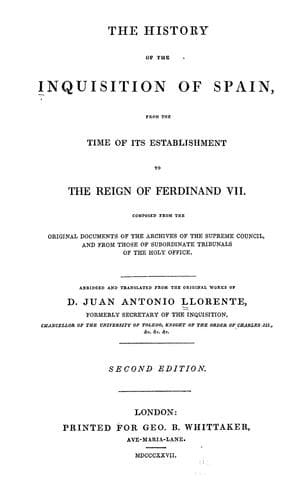
The History of the Inquisition of Spain from the Time of its Establishment to the Reign of Ferdinand VII.Llorente, Juan Antonio
History
The History of the Inquisition of Spain from the Time of its Establishment to the Reign of Ferdinand VII.
Llorente, Juan Antonio
Inquisition -- Spain
_Roman_ (Fray Jerome), an Augustine, born at Logroño. He was very
learned in the oriental languages, and directed his attention towards
the study of sacred and profane history. In prosecuting this design, he
travelled over a great part of Europe, examining the different archives,
and making extracts of all that appeared likely to increase the success
of the great works which he had projected. Being appointed historian to
his order, he published the history of it from the year 1569; in it he
gives an account of the lives of the saints and illustrious men who had
belonged to it, with many interesting details. His wish to publish the
historical facts which he had collected during his travels, induced him
to write a book called the _Republics of the World_; in this work he
treats very learnedly of the ancient and modern republics: it was
printed at Medina del Campo, in 1575, and again in 1595 at Salamanca.
Unfortunately for the author, it contained several truths which
displeased some persons powerful enough to injure him; he experienced
some persecution, and the Inquisition of Valladolid reprimanded him, and
ordered his work to be corrected. He died in 1597, leaving some MSS.
which are mentioned by Nicholas Antonio.
_Salazar_ (Fray Ambrose de), Dominican, and professor of theology at
Salamanca. The Inquisition of Valladolid tried him in 1559, on two
accusations: the first was founded on the declarations of Fray Dominic
de Roxas and Fray Louis de la Cruz, during their imprisonment: they
imputed to Fray Ambrose some propositions which tended to Lutheranism;
the second charge was founded on the favourable opinion which he had
given of the Catechism of Carranza. The trial was not continued, on
account of the death of Fray Ambrose in 1560, in the thirty-eighth year
of his age: it was supposed that fear, and his imprisonment in the holy
office, where Carranza was detained, hastened his death. He left, in
order to be printed, some _Commentaries on the first part of the Sum of
St. Thomas_.
Public-domain text, read in full here on John Shaqi.
Reviews
Reviews
No reviews yet
Be the first to share your thoughts on this work.
Elsewhere in the archive
Join the Discussion
Join the discussion
Sign in to leave a comment or review.
Sign InorCreate an account