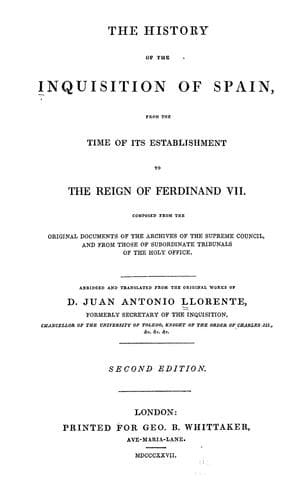
The History of the Inquisition of Spain from the Time of its Establishment to the Reign of Ferdinand VII.Llorente, Juan Antonio
History
The History of the Inquisition of Spain from the Time of its Establishment to the Reign of Ferdinand VII.
Llorente, Juan Antonio
Inquisition -- Spain
_Salas_ (Don Ramon de), born at Belchite in Aragon, was a professor at
Salamanca, and one of its greatest literati: he was prosecuted in 1796
by the Inquisition of Madrid, on suspicion of having adopted the
principles of the modern philosophers, Voltaire, Rousseau, and others,
whose works he had read. He acknowledged that he was acquainted with
their works, but added that he had only read them in order to refute
them, which he had done in several public theses, maintained at
Salamanca by some of his pupils, under his direction. All these theses
were introduced in the trial. He replied in a satisfactory manner to
all the allegations, and the qualifiers did not find anything in his
writings which deserved theological censure. The judges not only
acquitted him, but on being informed that Father Poveda, a Dominican,
had intrigued against him, thought that he had a right to a public
reparation. On the 22nd of October, in the same year, they sent their
sentence and the writings of the trial, together with the considerations
and the points of doctrine on which they were founded, to the Supreme
Council, at the same time expressing their opinion on the right of Salas
to a reparation.
Father Poveda, by his intrigues, caused the trial to be sent back to the
inquisitors, with an order to make fresh inquiries, which was done, but
the qualifiers and judges persisted in their first sentence. The
intrigues again began in the council, which returned the trial to the
Inquisition a second time, with an order to make another inquest
extraordinary: a third qualification, and a third sentence were the
result, confirming the innocence of Salas. This was not what was
intended; the accused had a powerful enemy in the council: this was Don
Philip Vallejo, archbishop of Santiago, and governor of the Council of
Castile; he had been inimical to Salas, from having had certain literary
discussions with him at the university of Salamanca, when he was bishop
of that see. The trial was suspended, to afford time for the archbishop
to procure new denunciations, to add to those he had already obtained.
Salas requested that his imprisonment might be ameliorated, and that he
might only be confined to the city of Madrid. The council refused this
favour; he then demanded permission to apply to the king, but this was
also refused. He was at last condemned to abjure _de levi_; received the
absolution and censures _ad cautelam_; and was banished from the
capital. He retired to Guadalaxara, and there complained to his
sovereign of the injustice of the Council of the Inquisition. Charles
IV. ordered the writings of the trial to be sent to his minister of
justice. Cardinal de Lorenzana, inquisitor-general, endeavoured to
prevent it, but his efforts were ineffectual. When the affair was
examined by the minister, the intrigue was discovered, and a resolution
was formed to expedite a royal ordinance, forbidding the inquisitors to
Public-domain text, read in full here on John Shaqi.
Reviews
Reviews
No reviews yet
Be the first to share your thoughts on this work.
Elsewhere in the archive
Join the Discussion
Join the discussion
Sign in to leave a comment or review.
Sign InorCreate an account