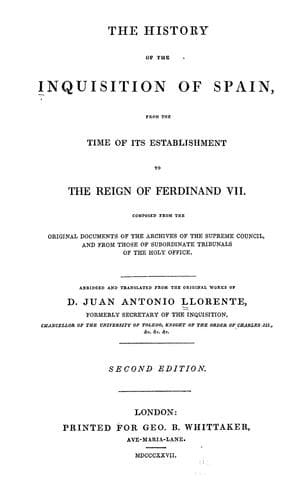
The History of the Inquisition of Spain from the Time of its Establishment to the Reign of Ferdinand VII.Llorente, Juan Antonio
History
The History of the Inquisition of Spain from the Time of its Establishment to the Reign of Ferdinand VII.
Llorente, Juan Antonio
Inquisition -- Spain
_Yeregui_ (Don Joseph de), secular priest, doctor of theology and canon
law, born at Vergara de Guipuzcoa: he was preceptor to the infants Don
Gabriel and Don Antonio de Bourbon, and knight of the royal order of
Charles III. He published a good catechism, and was denounced three
times to the Inquisition of Madrid, on suspicion of being a Jansenist.
In 1792, he was commanded not to go out of the city of Madrid. He lived
in this kind of captivity for six months, and was then acquitted by the
inquisitors of the court. Unfortunately he had enemies in the Supreme
Council, who wished to order the trial to be suspended, and they would
have succeeded if the inquisitor-general, Rubin de Cevallos, had not
died at that time. His successor, Don Manuel Abady-la-Sierra, archbishop
of Selimbria, professed the same opinions as Yeregui, who at last
received a certificate of absolution, and regained his liberty; the king
then appointed him to be an honorary inquisitor. Yeregui in his new
office incurred other inconveniences, because he had spoken to his
friends of the circumstances of his trial, which was interpreted as a
sign of contempt for the holy office, which always enjoins secrecy to
those who appear before it. Yeregui however apologized, and refuted all
that had been published concerning his opinions of the Inquisition.
_Zeballos_ (Jerome de), native of Escalona; he was a professor in the
university of Salamanca, and a member of the municipality of Toledo. In
1609 he published at Rome a volume in folio, containing several
treatises on jurisprudence; the first is a _Discourse on the principal
Reasons of the King of Spain and his Council, for taking Cognizance of
Ecclesiastical Trials, or Trials between Ecclesiastics, when a Writ of
Error is brought in_. Among the questions which he discusses, is the
following: "Is an ecclesiastical judge permitted to arrest and imprison
laymen in a trial on canonical affairs, without the intervention of the
royal judge?" The same author published at Salamanca, in 1613, another
volume in folio, entitled, _Of the Cognizance of Ecclesiastical Trials,
between Ecclesiastics, when an Appeal is made by one of the Parties to
the Royal Authority_. He wrote some other works recorded by Nicolas
Antonio. Some priests, who thought it heresy to defend the privileges of
the king against the power of the clergy, denounced Zeballos to the
Inquisition of Toledo. The members of this tribunal did not arrest him,
but sent him the heads of the accusations against the two works already
mentioned; he justified himself completely, and they were permitted to
be in circulation. Some time after the Inquisition of Rome placed them
on its Index, and that of Spain suppressed some passages, which are not
found in the modern editions.
Public-domain text, read in full here on John Shaqi.
Reviews
Reviews
No reviews yet
Be the first to share your thoughts on this work.
Elsewhere in the archive
Join the Discussion
Join the discussion
Sign in to leave a comment or review.
Sign InorCreate an account