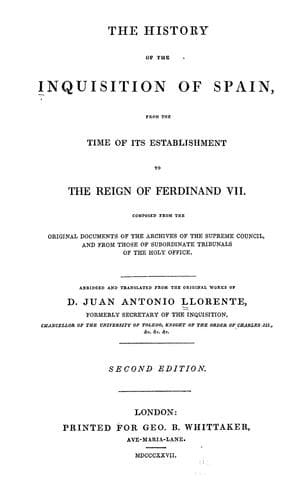
The History of the Inquisition of Spain from the Time of its Establishment to the Reign of Ferdinand VII.Llorente, Juan Antonio
History
The History of the Inquisition of Spain from the Time of its Establishment to the Reign of Ferdinand VII.
Llorente, Juan Antonio
Inquisition -- Spain
This list might have been augmented by the names of many less
distinguished men, and I did not think it necessary to include those
Spaniards whose works have been prohibited, but who were not personally
attacked by the holy office. Those already mentioned are sufficient to
show the danger of attempting to introduce the taste for good literature
in Spain.
Charles III., wishing to be made acquainted with the affairs of the
Jesuits, and some other circumstances relating to them, assembled a
council in 1768, composed of five archbishops and bishops; they were
occupied in consulting upon the tribunal of the Inquisition, and
particularly of the prohibition of books. Don Joseph Moñino, Count de
Florida-Blanca, and Don Pedro Rodriguez de Campomanes, Count de
Campomanes, the king's procurators in the Council of Castile, made a
report to the assembly. Some extracts from it will be interesting in
this part of the history.
Speaking of the clandestine introduction of a brief relating to the
Jesuits on the 16th of April, 1767, and of another concerning the
affairs of the Duke of Parma, on the 30th of January, 1768, these
ministers thus express themselves: "The council is not ignorant of the
intrigues employed by the nuncios with the Inquisition, to gain their
ends by clandestine means. During the first fifteen centuries there
were no tribunals of the Inquisition in Spain. The bishops alone were
acquainted with points of doctrine, and heretics and blasphemers were
punished by civil law. The abuse of the prohibitions of books commanded
by the Inquisition, is one cause of the ignorance which prevails over
the greatest part of this nation.... According to the bulls which
created the holy office, the bishops are joint judges with the
inquisitors, and sometimes the principal judges in the affairs which
depend on the tribunal. This power of the bishops was acquired by their
rank and their respectable office of pastors. Why then have these
natural judges of all discussions which may arise on matters of faith
and the morals of the faithful, no part or influence in the prohibitions
of books, and the choice of qualifiers? It is from this circumstance
that the subject has been treated with a negligence which excites and
perpetuates the complaints of learned men.... Supposing that the
regulations of Benedict XIV. were not sufficiently clear, the same
cannot be said of the brief of Innocent VIII., which commands the
Inquisition to follow the rules of justice in their proceedings: Can
there be anything more just, than that the parties should be heard? Is
it not contrary to the public interest, that books which might be useful
in instructing subjects should be prohibited, from passion, or to gain
some particular end? The fiscal would say too much if he dwelt upon this
subject, to prove how much the tribunal has always abused its authority,
in commanding the prohibition of doctrines which even Rome has not dared
Public-domain text, read in full here on John Shaqi.
Reviews
Reviews
No reviews yet
Be the first to share your thoughts on this work.
Elsewhere in the archive
Join the Discussion
Join the discussion
Sign in to leave a comment or review.
Sign InorCreate an account