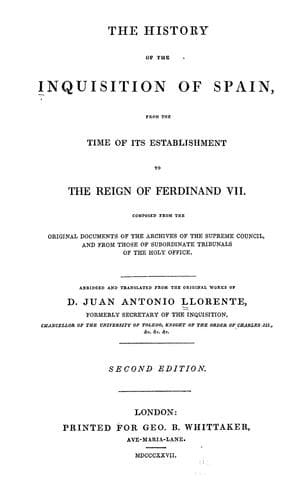
The History of the Inquisition of Spain from the Time of its Establishment to the Reign of Ferdinand VII.Llorente, Juan Antonio
History
The History of the Inquisition of Spain from the Time of its Establishment to the Reign of Ferdinand VII.
Llorente, Juan Antonio
Inquisition -- Spain
to submit to this interdict without an order from his bishop. The king
and the Pope were at last obliged to interfere, they re-established the
bishop in his rights; but this act of justice did not destroy the cause
of the evil which was complained of.
In the same year, the Inquisitors of Toledo excommunicated the
sub-prefect of that city, who had seized and sentenced a butcher as a
thief, and convicted him of having sold bad meat with false weights: the
inquisitors pretended that the culprit came under their jurisdiction,
because he furnished the holy office with meat, and they accordingly
required that the prisoners and the writings of the trial should be
given up to them. Their demand was refused, because the offence was
committed in the exercise of a public profession. The inquisitors then
published the excommunication in all the churches of Toledo; they
imprisoned the usher and the porter of the sub-prefect for having obeyed
their master, and they remained in prison several days; they were then
subject to the punishment of having their beards and hair shaven, which
was at that time considered infamous, and to appear in the chamber of
audience without their shoes and girdles; they were examined on their
genealogy, to discover if they were descended from the Moors or Jews;
they were made to repeat the catechism as if they were heretics, and
were then condemned to perpetual banishment; the inquisitors even
refused to give them a certificate, to show that they had not been
condemned for heresy. The compassion excited by the fate of these
unfortunate men was so general, that the people rose against the
Inquisition; but some persons of high rank, and who were devoted to the
public good, succeeded in appeasing the tumult. The king being informed
of what had passed by the Council of Castile, appointed an extraordinary
commission of eleven members selected from his councils; they passed
several resolutions against the inquisitors, which had only the effect
of correcting the present disorder, without entirely destroying the
evil.
In the following year, the Inquisitors of Grenada excommunicated Don
Louis Gudiel de Peralta, and Don Mathias Gonzalez; the first a member of
the royal civil court, and the other the king's procurator in the same
court. They condemned as heretical two works of these excellent
jurisconsults, in which they defended the rights of the royal
jurisdiction in all cases of _competence_. The Council of Castile
respectfully remonstrated with the king, and showed that the inquisitors
acted in opposition to _Instructions to the holy office of 1485_, which
directed them to consult the king in affairs of this nature. In order to
remedy this abuse, a committee was appointed in 1625, to decide upon all
difficulties which might arise on this subject. This committee did not
exist long, but it was re-established in 1657.
Public-domain text, read in full here on John Shaqi.
Reviews
Reviews
No reviews yet
Be the first to share your thoughts on this work.
Elsewhere in the archive
Join the Discussion
Join the discussion
Sign in to leave a comment or review.
Sign InorCreate an account