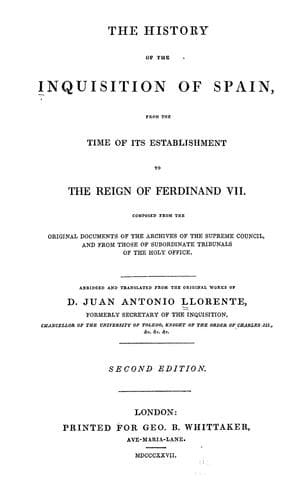
The History of the Inquisition of Spain from the Time of its Establishment to the Reign of Ferdinand VII.Llorente, Juan Antonio
History
The History of the Inquisition of Spain from the Time of its Establishment to the Reign of Ferdinand VII.
Llorente, Juan Antonio
Inquisition -- Spain
In 1598, the Inquisitors of Seville went to the metropolitan church,
with the president and members of the royal court of justice, to attend
the funeral of Philip II.; they pretended that they ought to precede the
judges, who resisted, and the inquisitors excommunicated them in the
church. The king's attorney protested against this act, and the
scandalous scene which ensued may be easily conceived. The judges
repairing to the place where they held their sessions, declared that the
inquisitors had used violence in proceeding against the law, and passed
a decree commanding the inquisitors to take off the excommunication. The
inquisitors did not obey the order, and the judges repeated it, with the
threat of depriving them of all civil rights, and condemning them to
banishment and confiscation. Philip III. disapproved of the conduct of
the inquisitors, commanded them to take off the excommunication and
repair to Madrid, where they were confined to the city. In the December
following, the king issued a decree, importing that the inquisitors
should only take precedence in the ceremony of the _auto-da-fé_. The
inquisitor-general Portocarrero was deprived of his office, and banished
to his bishopric of Cuença.
In 1622 the town of Lorca, which was within the jurisdiction of the
Inquisition of Murcia, appointed a familiar of the holy office to be the
collector of a tax upon the sale of goods called _Alcabala_. The man
refused the employment, but his representations were not admitted, upon
which the inquisitors excommunicated the judge of Lorca, and required
the assistance of Don Pedro Porres, the corregidor of Murcia, to take
him to their prisons. On his refusal, they excommunicated him also, and
decreed that divine service should cease in all the churches of Murcia.
This measure threw the inhabitants into the greatest consternation, and
they entreated their bishop, Don Antonio Trejo, to interpose his
authority. This prelate remonstrated with the inquisitors; but not
succeeding, in order to tranquillize the people, he published a mandate,
announcing that he was not obliged to submit to the interdict, or to the
order for the _cessation of divine service_. Don Andres Pacheco, the
inquisitor-general, condemned the mandate, and ordered this measure to
be proclaimed in all the churches of Murcia. At the same time he imposed
a penalty of eight thousand ducats on the bishop, and cited him to
appear within twenty days at Madrid, to answer the complaint preferred
against him, by the fiscal of the Supreme Council, on pain of another
penalty of four thousand ducats. The bishop and the chapter of his
cathedral sent the dean and a canon to Madrid as his deputies. The
inquisitor-general excommunicated them, without hearing their defence,
and threw them into separate prisons, and at the same time caused this
excommunication to be announced in all the pulpits of Madrid. The
inquisitors also excommunicated the Curé of St. Catherine, who refused
Public-domain text, read in full here on John Shaqi.
Reviews
Reviews
No reviews yet
Be the first to share your thoughts on this work.
Elsewhere in the archive
Join the Discussion
Join the discussion
Sign in to leave a comment or review.
Sign InorCreate an account