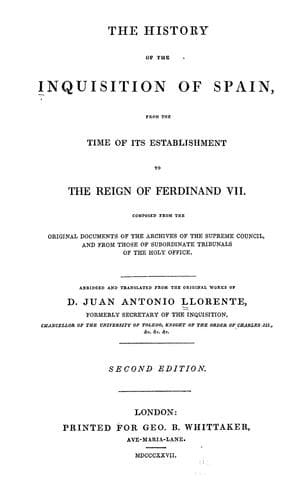
The History of the Inquisition of Spain from the Time of its Establishment to the Reign of Ferdinand VII.Llorente, Juan Antonio
History
The History of the Inquisition of Spain from the Time of its Establishment to the Reign of Ferdinand VII.
Llorente, Juan Antonio
Inquisition -- Spain
In 1686, a quarrel arose between the inquisitors of Carthagena in
America, and the bishop. The inquisitor Don Francis Barela, after
excommunicating the prelate, caused his decree to be read in all the
churches. The bishop replied, and showed by his manner to the
inquisitor, his contempt for the excommunication. Don Francis (in
concurrence with his consultors) arrested and threw into prison the
bishop and many respectable persons of the cathedral and the city, who
had spoken freely on the subject. The Pope being informed of this affair
on the 13th February, 1687, commanded the inquisitor-general, Don Diego
Sarmiento de Valladares, to cause the inquisitor Barela and the
consultors to be brought to Madrid, and to deprive them of their
offices. This order not being obeyed, on the 15th of December he
expedited a second brief, which was comminatory. The inquisitor-general
then had recourse to the king, and gave so unfaithful an account of the
transaction, that neither his majesty nor the council of the Indies were
ever informed of the truth. The Pope persisted in his resolution, and
wished to decide on the affair himself. It was not finished when Clement
XI. ascended the pontifical throne; this Pope assembled the cardinals,
and taking their opinions, confirmed by a formal decree all that the
bishop had done, and annulled the extravagant measures of the
inquisitor. A bull, in 1706, commanded the restitution of the penalties
which had been imposed, and suppressed the tribunal of Carthagena. This
suppression was not executed, because it was contrary to the king's
policy.
In 1713, the Cardinal Francis Judice, inquisitor-general, prohibited a
work of Don Melchior Macanaz, procurator of the king in the Council of
Castile: the cardinal knew that this work had been printed by the order
of Philip V., who had approved it after having read it. The king was at
first very much irritated at this proceeding; but the cardinal,
accustomed to the intrigues of Rome and Paris, succeeded in eluding the
orders of his sovereign; although he was not in the kingdom, he
continued to exercise his office, and sent orders to his creatures which
were extremely displeasing to Philip. This prince could not obtain the
dismission of Judice, until Cardinal Alberoni had exerted his influence
at Rome and Paris, to second his master's views. Judice retired in 1716.
Public-domain text, read in full here on John Shaqi.
Reviews
Reviews
No reviews yet
Be the first to share your thoughts on this work.
Elsewhere in the archive
Join the Discussion
Join the discussion
Sign in to leave a comment or review.
Sign InorCreate an account