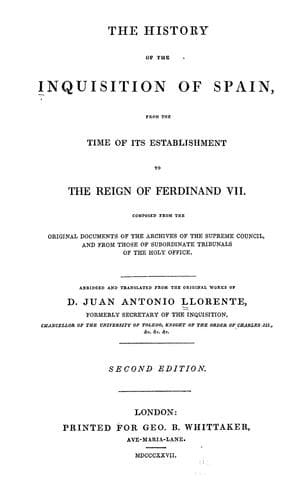
The History of the Inquisition of Spain from the Time of its Establishment to the Reign of Ferdinand VII.Llorente, Juan Antonio
History
The History of the Inquisition of Spain from the Time of its Establishment to the Reign of Ferdinand VII.
Llorente, Juan Antonio
Inquisition -- Spain
Don Melchior Macanaz continued to live in exile. His trial became
important, from the great number of denunciations which were made
against different works which he had written: in some of these he
inveighed against the abuses which were committed at the Court of Rome,
against those of the immunities of the clergy and of the ecclesiastical
tribunals, and called the public attention to the fatal effects of
increasing the number of monks and other societies. The qualifiers, in
judging his works, clearly showed the spirit of hatred and revenge which
actuated them. In the trial of Macanaz, one of his works, called _A
Critical Defence of the Inquisition_, is mentioned; the inquisitors
qualified it as _ironical_, because they found some things in it which
were not true. They were confirmed in their opinion some time after, by
another work of Macanaz, called _An Apology for the Defence of Fray
Nicolas Jesus de Belando, in Favour of the Civil History of Spain,
unjustly prohibited by the Inquisition_.
Although the inquisitors treated him with so much severity, Ferdinand
VI., and the inquisitor-general Don Manuel Quintano Bonifaz, permitted
Macanaz to return to Spain, and the king sent him to Aix-la-Chapelle as
his ambassador.
In 1768, the inquisitors endeavoured to obtain the right of trying
persons for polygamy: Charles III. ordered that the cognizance of this
offence should belong to the secular judge, except when the criminals
thought that it was permitted. It was his pleasure that the inquisitors
"should only punish heresy and apostasy, and, above all, that none of
his people should be subjected to the disgrace of an arrest, if they had
not been previously convicted of a crime."
In 1771, the Council of the Inquisition represented to the king, that
the simple fact of marrying another person, while the first wife was
alive, was sufficient to create a suspicion that the persons guilty of
it erred in faith on the article of marriage. For this reason the
inquisitors continued to receive the denunciations on this pretended
heresy, and to take cognizance of it.
In 1781, the inquisitor-general commanded that the confessionals in the
convents of nuns should be placed within sight of the persons in the
churches. This was done by the inquisitors, without consulting the
archbishops and bishops of the dioceses; they were extremely offended
at this conduct, but dissembled their anger, that the public
tranquillity might not be disturbed.
Public-domain text, read in full here on John Shaqi.
Reviews
Reviews
No reviews yet
Be the first to share your thoughts on this work.
Elsewhere in the archive
Join the Discussion
Join the discussion
Sign in to leave a comment or review.
Sign InorCreate an account