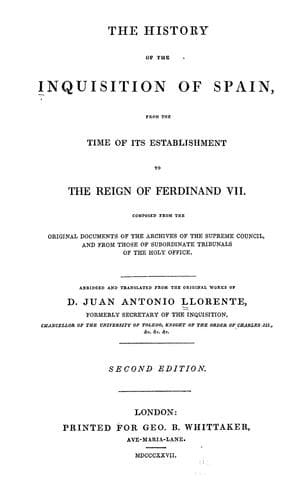
The History of the Inquisition of Spain from the Time of its Establishment to the Reign of Ferdinand VII.Llorente, Juan Antonio
History
The History of the Inquisition of Spain from the Time of its Establishment to the Reign of Ferdinand VII.
Llorente, Juan Antonio
Inquisition -- Spain
_Aranda_ (Don Pedro-Paul Abarca de Bolea y Ximenez d'Urrea, Count d'),
grandee of Spain. He rendered himself more illustrious by his talents
and learning than he was by his birth and high offices. As a soldier he
attained the rank of Captain-general, which is equivalent to that of
Field-marshal: his diplomatic talents obtained the office of ambassador
to Paris; his knowledge as a statesman, that of prime-minister,
secretary of state, under Charles IV.; and for his talents as a
politician he was made president of the Council of Castile. In these
four branches of the art of governing he was always truly great. He was
president in the royal council extraordinary, assembled by Charles III.
to consider the affairs of the Jesuits. Although the members of this
assembly deliberated in secret, the public were informed not only of its
objects in general, but the particular opinions of each councillor. The
Count d'Aranda was denounced to the holy office as being suspected of
professing the sentiments of the philosophers of the eighteenth century,
because his political opinions were extremely liberal. The ordinance
signed by Charles III. in 1770 (forbidding the inquisitors to take
cognizance of any crime but heresy) was thought to be the work of the
Count d'Aranda, and the inquisitors hated him in consequence. The trial
of Don Paul Olavide, which took place about this time, furnished some
details which caused a suspicion that the opinions of the Count d'Aranda
on the subject of mere exterior devotion were the same as those of the
accused. However the inquisitors could not obtain a sufficient mass of
evidence to authorize proceedings against him, and he died after having
been denounced four times to the holy office, but without ever being put
upon his trial.
_Arroyo_ (Don Stephen d'), corregidor of Ecija, a town in Andalusia, and
a member of the royal civil court of the district of Granada. He was
excommunicated by the Inquisition of Cordova in 1664, because he opposed
the attempts made by the inquisitors to extend their jurisdiction at the
expense of the civil tribunals.
_Avalos_ (Don Diego Lopez d'), corregidor of the city of Cordova, was
threatened to be excommunicated and imprisoned in 1501, because he
refused to give up two archers of the holy office, who had been taken to
the royal prison, unless they were demanded with the proper forms.
Public-domain text, read in full here on John Shaqi.
Reviews
Reviews
No reviews yet
Be the first to share your thoughts on this work.
Elsewhere in the archive
Join the Discussion
Join the discussion
Sign in to leave a comment or review.
Sign InorCreate an account