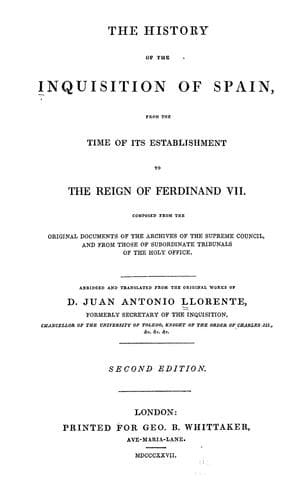
The History of the Inquisition of Spain from the Time of its Establishment to the Reign of Ferdinand VII.Llorente, Juan Antonio
History
The History of the Inquisition of Spain from the Time of its Establishment to the Reign of Ferdinand VII.
Llorente, Juan Antonio
Inquisition -- Spain
_Azara_ (Don Joseph Nicolas d'), born in Aragon, was successively
director of the office of the minister for foreign affairs, minister
plenipotentiary at Rome, and ambassador extraordinary to Paris. He
published a translation of the _Life of Cicero_, with notes,
illustrations, and plates. He was considered one of the most learned men
in Spain during the reigns of Charles III. and his successor. Although
he almost always resided in Italy or France, his name was in the
registers of the holy office. He was denounced at Saragossa and Madrid
as an incredulous philosopher; but there were no proofs, and the trial
was suspended until fresh charges should be brought against him.
_Aragon_ (the deputation of). See the preceding Article.
_Aragon._ The Chief Justice of Aragon was invested with supreme power,
and placed between the king and the nation, to decide without appeal, if
the king's ministers infringed the laws established at the beginning of
the monarchy. Even the king was obliged to submit to the decisions of
this magistrate in all constitutional affairs. In order to prevent
disputes between the two powers, the chief justice and his tribunal were
independent of the king in the criminal proceedings. The inquisitors of
Saragossa, regardless of these regulations, commenced proceedings
against the chief justice, and in 1591 threatened to excommunicate him.
Some account of this affair will be given in the trial of Antonio Perez.
_Bañüelos_ (Don Vincent) was excommunicated by the Inquisition of
Toledo, for endeavouring to defend the jurisdiction of the civil
tribunal in a trial for homicide.
_Barcelona._ See the preceding Article.
_Barrientos_ (the commandant), knight of the military order of St. Jago,
and Corregidor and Sub-prefect of Logroño, was obliged, in 1516, to go
to Madrid, and appear before the inquisitor-general of the Supreme
Council, to ask pardon for having refused to lend assistance to the
archers of the holy office in arresting some monks. He was subjected to
the lesser _auto-da-fé_, attended mass, standing with a torch in his
hand, and received some slight strokes of a whip from the inquisitor;
this ceremony was concluded by a solemn absolution from all censures.
_Benalcazar_ (the Count de) was excommunicated and menaced with an
arrest by the inquisitors of Estremadura in 1500. The same threat was
made to the governor of the fortress of Benalcazar; their offence was
having defended their temporal power against the pretensions of the holy
office, in the case of a woman who was arrested for having uttered some
words against the faith.
Public-domain text, read in full here on John Shaqi.
Reviews
Reviews
No reviews yet
Be the first to share your thoughts on this work.
Elsewhere in the archive
Join the Discussion
Join the discussion
Sign in to leave a comment or review.
Sign InorCreate an account