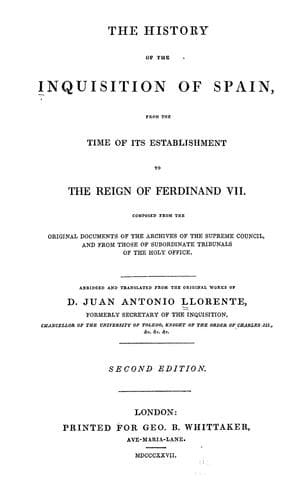
The History of the Inquisition of Spain from the Time of its Establishment to the Reign of Ferdinand VII.Llorente, Juan Antonio
History
The History of the Inquisition of Spain from the Time of its Establishment to the Reign of Ferdinand VII.
Llorente, Juan Antonio
Inquisition -- Spain
_Jovellanos_ (Don Gaspard Melchior de), Secretary of State in the
department of grace and justice under Charles IV., was one of the most
learned men in Spain; he wrote several pamphlets on politics and
different branches of literature. In 1798 he resolved to reform the mode
of proceeding in the holy office, and intended to take advantage of a
memorial which I had composed in 1794, according to the orders of the
inquisitor-general Abad-y-la-Sierra; but from a secret court intrigue he
was denounced to the Inquisition as a Jansenist and an enemy to the
tribunal. Charles IV. was persuaded first to banish him to his native
place Gijon, in the Asturias, and afterwards to confine him in the
Chartreuse, in the island of Majorca, where he was informed that he was
to study the Christian doctrine. This treatment was extremely unjust,
for Jovellanos was not only a good Catholic, but a just and
irreproachable man, whose memory will do honour to Spain.
_Juan_ (D. Gabriel de), president of the royal Court of Appeal at
Majorca, was excommunicated in 1531; he maintained the rights of the
sovereign against the inquisitors.
_Lara_ (Don Juan Perez de), procurator to the king, and fiscal of the
royal Court of Appeal at Seville, was extremely ill-treated by the
inquisitors in 1637, because he maintained the rights of the royal
jurisdiction in a manifesto, which the inquisitors declared contained
propositions offensive to the holy office.
_Macanaz_ (Don Melchior de). See the preceding article.
_Moñino_ (Don Joseph), Count de Florida-Blanca, first secretary of state
under Charles III., and Charles IV. He had been successively an advocate
at Madrid, procurator to the king and fiscal of the Council of Castile,
and minister plenipotentiary at Rome. His celebrity as a lawyer was the
origin of his elevation, and his subsequent conduct fully justified the
favourable opinion which had been formed of him. In his quality of
fiscal he wrote several works. Don Juan Sempere Guarinos, in his
_Catalogue of the Authors of the Reign of Charles III._, has inserted
notices of those which had been printed and those which remained
unpublished. Among the first are some of great merit: the _Advice of a
Fiscal_, which he gave to the council on the memorial presented to
Charles III. by Don Isidro Carbajal y Lancaster, Bishop of Cuença, and
on the _impartial judgment_ of the brief issued by Clement XIII. against
the sovereign Duke of Parma, induced some ignorant and prejudiced
priests to denounce him to the Inquisition as an enemy to religion. The
Count furnished them with additional arms against himself, when he gave
his opinion as procurator-fiscal on the abuses committed by the
inquisitors in the prohibition of books, and on the system which they
had adopted of taking cognizance of crimes not relating to doctrine.
However, the inquisitors, not finding in his writings any proposition
which might be qualified as heretical, were afraid to continue the trial
Public-domain text, read in full here on John Shaqi.
Reviews
Reviews
No reviews yet
Be the first to share your thoughts on this work.
Elsewhere in the archive
Join the Discussion
Join the discussion
Sign in to leave a comment or review.
Sign InorCreate an account