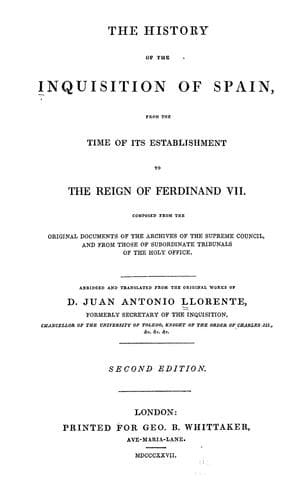
The History of the Inquisition of Spain from the Time of its Establishment to the Reign of Ferdinand VII.Llorente, Juan Antonio
History
The History of the Inquisition of Spain from the Time of its Establishment to the Reign of Ferdinand VII.
Llorente, Juan Antonio
Inquisition -- Spain
_Campomanes_ (Don Pedro Rodriguez de Campomanes, Count de) was, perhaps,
the most eminent literary man in Spain, during the reigns of Charles
III. and Charles IV. He is the author of several works mentioned in the
_Spanish Library of the time of Charles III._ published by Don Juan de
Sempere Guarinos. He first filled the office of procurator to the king
in the Council of Castile, and in the chamber of the king, of which he
was afterwards the governor. In all his works he constantly maintained
the independence of sovereigns with respect to the Court of Rome, the
obligation that all the citizens of the state should pay their part of
the public expenses, and the impossibility that the contentious
jurisdiction should form part of the ecclesiastical power, unless
accorded by the special favour of the sovereign. It is easy to suppose
that Campomanes had a great many enemies among the clergy; he was
denounced to the holy office as an anti-catholic philosopher. The
charges were numerous, but they did not prove that he had advanced any
heretical proposition; they only tended to create a suspicion that his
works were opposed to the spirit of Christianity. He was invited to
attend the _auto-da-fé_ of Don Paul Olavide, in order to inform him of
the punishment he would incur by professing the same opinions; but
though the inquisitors knew him to be their enemy, they did not dare to
go any further.
_Cardona_ (Don Pedro de), captain-general of Catalonia. See Chapter 16.
_Castile_ (Council of). See preceding Article.
_Chaves_ (Don Gregorio Antonio de), corregidor and sub-prefect of
Cordova, was excommunicated and threatened with imprisonment by the
inquisitors of Cordova in 1660.
_Chumacero_ (Don Juan), Count de Guaro, president of the Council of
Castile, ambassador at Rome, composed several works which are mentioned
by Nicolas Antonio, and some discourses in defence of the temporal
against the ecclesiastical power, and in favour of the independence of
sovereigns against the abuses of the Court of Rome. The inquisitors of
Spain, at the instigation of the Pope's nuncio, undertook to condemn his
doctrine, and to prohibit his works, with those of some other authors
who wrote in the same spirit, in order to force them to retract, on
pain of excommunication and imprisonment.
_Cordova_ (Don Pedro Fernandez de), Marquis de Priego, member of the
municipality of Cordova, was persecuted by the Inquisition in 1506. See
Chapter 10.
_Cordova_ (Don Diego Fernandez de), Count de Cabra, and also a member of
the municipality of Cordova, was treated in the same manner. _Ibid._
_Godoy_ (Don Manuel), Prince of Peace, Duke of Alcudia, secretary of
state to Charles IV. See Chapter 43.
_Gonzalez_ (Don Mathias). See the preceding Article.
_Gudiel_ (the Licentiate). _Ibid._
_Gudiel de Peralta_ (Don Louis). _Ibid._
_Guzman_ (Don Gaspar de), Count-Duke d'Olivarez, prime minister to
Philip IV. See Chapter 37.
_Izquierdo_ (the Licentiate). See the preceding Article.
Public-domain text, read in full here on John Shaqi.
Reviews
Reviews
No reviews yet
Be the first to share your thoughts on this work.
Elsewhere in the archive
Join the Discussion
Join the discussion
Sign in to leave a comment or review.
Sign InorCreate an account