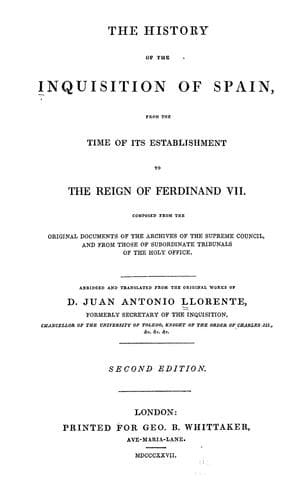
The History of the Inquisition of Spain from the Time of its Establishment to the Reign of Ferdinand VII.Llorente, Juan Antonio
History
The History of the Inquisition of Spain from the Time of its Establishment to the Reign of Ferdinand VII.
Llorente, Juan Antonio
Inquisition -- Spain
When he heard his sentence he fainted, and fell off the bench on which
he had been permitted to sit. When he had recovered, and the reading of
the sentence was finished, he received absolution on his knees, after
having read and signed his profession of faith; he was then taken back
to the prison. The sixty individuals who were invited to this ceremony
were dukes, counts, marquises, generals, members of the councils, and
knights of different military orders; they were most of them his
friends. These persons were, from some circumstances in the trial,
suspected of partaking his opinions, and the invitation was intended to
inform them of what they might expect, and to induce them to be more
reserved in their conversation. Olavide went to the convent where he was
to be confined, but made his escape some time after, and retired to
France. He lived at Paris under the name of the _Count de Pilo_, a title
which he had never borne in Spain. A few years after he published a
work, called _The Gospel Triumphant; or, the Converted Philosopher_.
This composition obtained his pardon, and permission to return to Spain,
where no penances were imposed on him.
_Perez_ (Antonio). See Chapter 35.
_Ramos del Manzano_ (Don Francis), Count de Francos, tutor of Charles
II. and president of the Sovereign Council of the Indies, composed some
treatises on politics, which are mentioned by Nicolas Antonio. In these
writings he maintains the prerogatives and independence of the
sovereigns against the indirect powers of the Popes, the abuses of the
Court of Rome, and the ecclesiastical judges in the holy office. The
Count de Francos suffered much persecution, and his works were
prohibited; if Philip IV. had not protected him, he would have been
arrested, and his books burnt.
_Ricla_ (the Count de), minister of war, and lieutenant-general in the
army under Charles III., was denounced to the holy office as having
adopted the opinions of the philosophers of the eighteenth century.
There was not sufficient proof against him, and the trial was suspended.
_Roda_ (Don Manuel de), Marquis de Roda, minister and secretary of state
in the department of grace and justice, under Charles III. He had been a
celebrated advocate at Madrid, and minister-plenipotentiary at Rome; his
talents and learning made him of the greatest use to Charles III. in the
important affairs relative to the expulsion of the Jesuits. The
imputation of Jansenism, incurred by the archbishops and bishops of the
Council extraordinary, was also brought against this minister, who had
made many enemies by advising Charles III. to reform the six great
colleges established at Salamanca, Alcala, and Valladolid. This
denunciation failed, because it contained no _particular proposition_
which deserved to be censured.
Public-domain text, read in full here on John Shaqi.
Reviews
Reviews
No reviews yet
Be the first to share your thoughts on this work.
Elsewhere in the archive
Join the Discussion
Join the discussion
Sign in to leave a comment or review.
Sign InorCreate an account