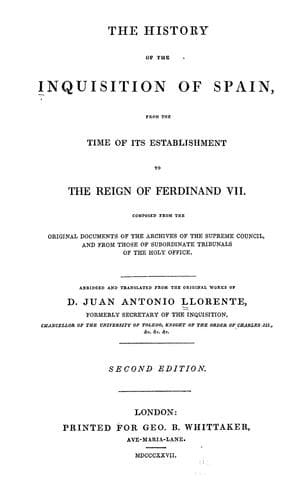
The History of the Inquisition of Spain from the Time of its Establishment to the Reign of Ferdinand VII.Llorente, Juan Antonio
History
The History of the Inquisition of Spain from the Time of its Establishment to the Reign of Ferdinand VII.
Llorente, Juan Antonio
Inquisition -- Spain
_Salcedo_ (Don Pedro Gonzalez de), procurator to the king in the Council
of Castile, published a treatise _On Political Law_, and some other
works, in which he attacked the abuses committed by the judges of the
privileged tribunals, and the pretensions of the inquisitors and other
ecclesiastics to the royal jurisdictions. He was persecuted, and his
works were condemned, but Philip IV. revoked the prohibition; however
some passages were afterwards retrenched, and they are not found in the
later editions.
_Salgado_ (Don Francis de), member of the Council of Castile, published
some works in defence of the royal jurisdiction against the
ecclesiastical authority; they are mentioned by Nicolas Antonio. The
Court of Rome condemned them; the inquisitors of Spain persecuted the
author, but when they were on the point of publishing the prohibition of
his works, Philip IV. commanded them to suspend their proceedings.
_Samaniego_ (Don Philip de), priest, archdeacon of Pampeluna, knight of
the order of St. James, counsellor to the king, and chief secretary and
interpreter of foreign languages. He was invited to attend the
_auto-da-fé_ of Don Paul Olavide, and was so alarmed that he voluntarily
denounced himself. He presented a declaration, in which he confessed
that he had read prohibited books, such as those of Voltaire, Mirabeau,
Rousseau, Hobbes, Spinosa, Montesquieu, Bayle, d'Alembert, Diderot, and
others; that from this course of reading he had fallen into a religious
pyrrhonism; that having thought seriously on the subject, he had
resolved to remain firmly attached to the Catholic faith, and that in
consequence he had resolved to demand to be absolved from the censures
_ad cautelam_. The tribunal ordered that he should confirm his
declaration by taking an oath. They then obliged him to confess by what
means he had obtained the books, whom he had received them from, and
where they were at that time; with what persons he had conversed on the
subject of religion, and revealed his opinions; what individuals had
refuted or adopted them; who had appeared to be ignorant of the
doctrine, or were acquainted with it; and lastly, how long he had known
it himself: these declarations were the conditions on which he was to
receive absolution. Samaniego wrote a declaration, in which almost all
the learned men of the court were implicated. Some of these persons had
been invited to the _auto-da-fé_ of Don Paul Olavide.
_Sardinia_ (the viceroy of) was excommunicated in 1498, and punished by
the inquisitors for having lent assistance to the Archbishop of Cagliari
in taking a criminal from the prisons of the holy office to those of the
archbishopric.
Public-domain text, read in full here on John Shaqi.
Reviews
Reviews
No reviews yet
Be the first to share your thoughts on this work.
Elsewhere in the archive
Join the Discussion
Join the discussion
Sign in to leave a comment or review.
Sign InorCreate an account