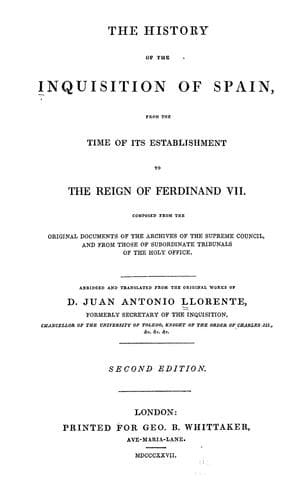
The History of the Inquisition of Spain from the Time of its Establishment to the Reign of Ferdinand VII.Llorente, Juan Antonio
History
The History of the Inquisition of Spain from the Time of its Establishment to the Reign of Ferdinand VII.
Llorente, Juan Antonio
Inquisition -- Spain
_Sesé_ (Don Joseph de), president of the royal Court of Appeal of the
kingdom of Aragon. This magistrate wrote a work, in which he had
collected many definitive sentences which had been pronounced in trials
for competency; they were all favourable to the secular power. The
author was the victim of his zeal; he was persecuted, and his work
prohibited, but Philip IV. caused it to be revoked.
_Solorzano_ (Don Juan de), member of the Sovereign Council of the
Indies. He was the author of a work on _Indian Politics_, and several
others of the same nature. They were written in the same spirit as those
of Salgado; Solorzano and his works shared his fate.
_Sotomayor_ (Don Guiterre de), knight commander of the order of
Alcantara, brother of the Count de Benalcazar, and governor of the
fortress of that name. See _Benalcazar_.
_Terranova_ (the Marquis de). See Chapter 16.
_Toledo_ (the royal judge of) was excommunicated, imprisoned, and
received much ill treatment from the inquisitors in 1622, in a contest
for jurisdiction.
_Valdés_ (Don Antonio), member of the royal Council of Castile. He was
excommunicated by the inquisitors in 1639, because he refused to exempt
the familiars of the holy office who possess land, from paying a
contribution.
_Valencia_ (the viceroy of), captain-general, was obliged in 1488, to
appear before the Supreme Council of the Inquisition, and ask pardon and
absolution for having set at liberty a soldier who was detained in the
prisons of the holy office. He had the mortification of being obliged to
appear in a _lesser auto-da-fé_.
_Vera_ (Don Juan-Antonio de). See Chapter 36.
_Zarate_ (Diego Ruiz de), chief alcade of Cordova, was punished by the
Supreme Council in 1500, and suspended from his office for six months,
because he refused to allow the inquisitors of Cordova to take
cognizance of the trial of the chief alguazil of that city.
Many other instances might be quoted: but these are sufficient to show
that the nature of the tribunal of the holy office will be contrary to
the independence of the sovereign, while the royal jurisdiction is
confounded with that of the inquisitors, and while the members of the
holy office are exempted from the civil and criminal jurisdiction of the
royal tribunals.
CHAPTER XXVII.
OF THE TRIALS OF SEVERAL SOVEREIGNS AND PRINCES UNDERTAKEN BY THE
INQUISITION.
Public-domain text, read in full here on John Shaqi.
Reviews
Reviews
No reviews yet
Be the first to share your thoughts on this work.
Elsewhere in the archive
Join the Discussion
Join the discussion
Sign in to leave a comment or review.
Sign InorCreate an account