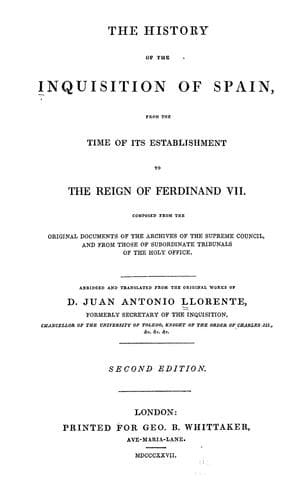
The History of the Inquisition of Spain from the Time of its Establishment to the Reign of Ferdinand VII.Llorente, Juan Antonio
History
The History of the Inquisition of Spain from the Time of its Establishment to the Reign of Ferdinand VII.
Llorente, Juan Antonio
Inquisition -- Spain
CHAPTER XXVIII.
OF THE CONDUCT OF THE HOLY OFFICE TOWARDS THOSE PRIESTS WHO ABUSED THE
SACRAMENT OF CONFESSION.
While the Inquisition was occupied in persecuting the peaceable
Lutherans, they were obliged to take measures to punish Catholic
priests, who abused the ministry of confession, by seducing their
penitents. The inquisitors were compelled to act with great reserve and
caution in this affair, that they might not furnish the Lutherans with
new arguments against auricular confession, and the Catholics with a
motive for employing it less frequently.
On the 18th of January, 1556, Paul IV. addressed a brief to the
Inquisitors of Granada, in which his Holiness commanded them to
prosecute those priests whom the _public voice_ accused of seduction,
and not to pardon _one_ of them. He also recommended that they should
ascertain if the doctrine of the priests on the sacrament of penitence
was orthodox, and if it was necessary to pursue the course prescribed
for the prosecution of heretics. The inquisitors communicated this brief
to the Archbishop of Granada, and the Council of the Inquisition, which
informed them in reply, that the publication of the brief in the usual
form would produce great inconveniences, and that it was necessary to
act with prudence and moderation.
For this reason the archbishop summoned the curés, and other
ecclesiastics, while the inquisitors did the same with the prelates of
the regular communities, to recommend to them to notify the brief of the
Pope to all the confessors, that they might be more strict in their
conduct for the future, and that the people might not be made acquainted
with the order of his Holiness. At the same time, informations were
taken against those who were suspected, and some who were guilty were
privately punished under other pretexts.
This measure convinced the Pope that the abuse was not confined to the
kingdom of Granada; and, in 1561, he addressed a brief to the
inquisitor-general Valdés, authorizing him to proceed against the
confessors guilty of this crime in the domains of Philip, as if they
were heretics. As this bull did not affect the inquisitors-general who
succeeded Valdés, several others were afterwards expedited.
It was the custom to read the _Edict of Denunciations_ in the churches
every year, on some Sunday in Lent, and as the number of crimes
increased, new articles were added to the Edict. The inquisitors of some
provinces introduced that of the priests who corrupted their penitents,
and Raynaldus Gonzalvius Montanus, speaking of the occurrences at
Seville after the publication of this edict, declares that it was
published in 1563, and that the denunciations were so numerous that the
notaries of the holy office refused to receive them, and that the
inquisitors were obliged to relinquish the prosecution of the criminals.
Public-domain text, read in full here on John Shaqi.
Reviews
Reviews
No reviews yet
Be the first to share your thoughts on this work.
Elsewhere in the archive
Join the Discussion
Join the discussion
Sign in to leave a comment or review.
Sign InorCreate an account