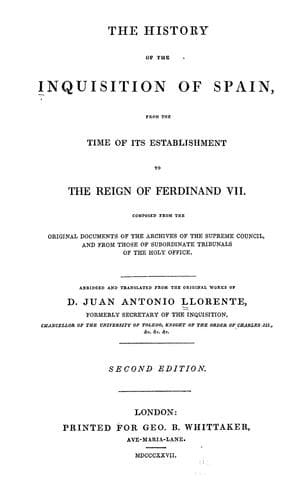
The History of the Inquisition of Spain from the Time of its Establishment to the Reign of Ferdinand VII.Llorente, Juan Antonio
History
The History of the Inquisition of Spain from the Time of its Establishment to the Reign of Ferdinand VII.
Llorente, Juan Antonio
Inquisition -- Spain
The edict was not published till 1564, and the denunciations were much
less numerous than he pretends. The denunciations ceased, because the
obligation imposed on the penitents to inform against the criminals was
annulled by the Supreme Council. Several other edicts were afterwards
published on this subject, and they were framed to include a great
number of cases.
This crime is never punished in a public _auto-da-fé_, because it might
prevent the faithful from confessing themselves. The _auto-da-fé_ was
held in the hall of the holy office; the secular confessors were
summoned to attend it, two from each of the establishments in the town,
and four from that of the condemned person, if there were any. No laymen
were permitted to be present, except the notaries. When the sentence,
and the motives for it, had been read, the dean of the inquisitors
exhorted the criminal to acknowledge his crime, and prepared him to make
the abjuration of all heresies in general, and of that of which he was
suspected in particular. He then placed himself on his knees, pronounced
his confession of faith, and signed his abjuration: the inquisitor
absolved him _ad cautelam_ from all the censures he had incurred: this
act terminated the _auto-da-fé_, the criminal was taken back to the
prison, and the next day he was transferred to the convent in which he
was to be imprisoned, according to his sentence. The confessors who
attended this ceremony, were commanded to inform others of the affair,
to deter them from committing the same crime.
CHAPTER XXIX.
OF THE TRIALS INSTITUTED BY THE INQUISITION AGAINST THE PRELATES AND
SPANISH DOCTORS OF THE COUNCIL OF TRENT.
_Prelates._
Eight venerable prelates and nine doctors of theology, who were sent by
Spain to the Council of Trent, were attacked in secret by the
Inquisition of their country. From particular circumstances, rather than
from the will of the inquisitors, some of these trials were suspended,
before any attempt had been made on the liberty of the doctors.
The trial of the Archbishop of Toledo ought to be introduced in this
place, but its importance and interest renders it worthy of a separate
chapter.
Public-domain text, read in full here on John Shaqi.
Reviews
Reviews
No reviews yet
Be the first to share your thoughts on this work.
Elsewhere in the archive
Join the Discussion
Join the discussion
Sign in to leave a comment or review.
Sign InorCreate an account