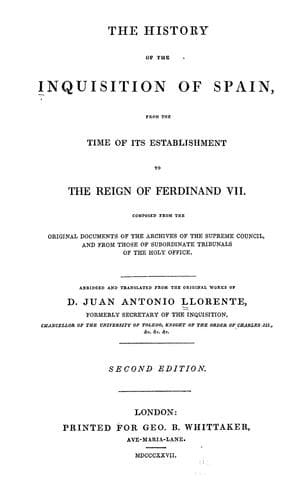
The History of the Inquisition of Spain from the Time of its Establishment to the Reign of Ferdinand VII.Llorente, Juan Antonio
History
The History of the Inquisition of Spain from the Time of its Establishment to the Reign of Ferdinand VII.
Llorente, Juan Antonio
Inquisition -- Spain
_Don Antonio Gorrionero_, bishop of Almeria, was prosecuted for his
favourable opinion of the Catechism, and some letters which he wrote on
the subject. He however attended the third convocation of the council of
Trent, which took place in 1560, and the following years.
_Don Fray Melchior Cano_, born in Tarancon, in the province of Cuença:
he had resigned the bishopric of the Canaries, and attended the second
session of the Council of Trent, in 1552. He was a member of the order
of St. Dominic, as well as Carranza, and his rival in the government and
administration of the affairs of his order, particularly after Carranza
had obtained the preference, when they were both candidates for the
office of Provincial of Castile. When the Catechism was denounced to the
Inquisition, Valdés appointed Cano to examine it, affecting to favour
its author, by choosing qualifiers from the monks of his order, but not
doubting, at the same time, that the opinion of Fray Melchior would be
unfavourable.
Fray Melchior examined the catechism, and some inedited works of
Carranza; but it appears that he did not strictly observe the secrecy
recommended by the inquisitors, since Carranza received information of
what was passing, while he was in Flanders, and wrote to Fray Melchior,
who replied to him from Valladolid, in 1559. About this time, Fray
Dominic de Roxas, and some other Lutherans confined in the secret
prisons of the holy office, deposed to certain facts, which caused some
suspicion of Fray Melchior.
However, the prosecution begun against him had no result; for at the
time when Cano was about to be reproved by the inquisitor-general, he
offered him the dedication of his Treatise _de Locis Theologicis_, which
was accepted; and as he had not time to publish it, he left it to the
inquisitor-general in his will, some time before his death, which
happened in 1560. His censure of the Catechism of Carranza, and some
propositions which he had maintained against the archbishop, and which
caused the faith of that prelate to be suspected, contributed to
preserve him from punishment. His calumnious discourse concerning
Carranza was no doubt the reason why he was thought to be his denouncer.
Public-domain text, read in full here on John Shaqi.
Reviews
Reviews
No reviews yet
Be the first to share your thoughts on this work.
Elsewhere in the archive
Join the Discussion
Join the discussion
Sign in to leave a comment or review.
Sign InorCreate an account