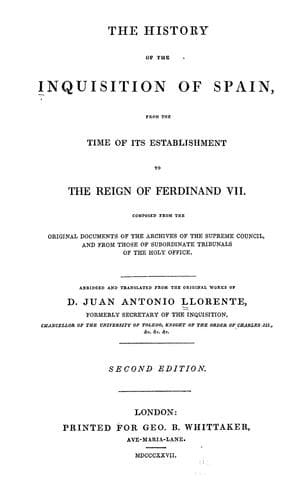
The History of the Inquisition of Spain from the Time of its Establishment to the Reign of Ferdinand VII.Llorente, Juan Antonio
History
The History of the Inquisition of Spain from the Time of its Establishment to the Reign of Ferdinand VII.
Llorente, Juan Antonio
Inquisition -- Spain
Arias returned to Spain, where the reputation he had acquired caused
many persons to become his enemies, particularly among the Jesuits,
because he had not consulted Diego Lainez, Alphonso Salmeron, or the
other Jesuits of the Council of Trent: he made another enemy in Leon de
Castro, a secular priest, professor of the oriental languages at
Salamanca, because he did not consult the university, and employ him in
the work. The certainty that he should be protected by the Jesuits
induced him to denounce Arias Montano to the Inquisition of Rome: this
denunciation was in Latin: he addressed another, in Spanish, to the
Supreme Council at Madrid. Leon de Castro accused him of having given
the Hebrew text of the Bible according to the Jewish MSS., and of having
made the version accord with the opinions of the rabbis, without
regarding those of the fathers of the church. He also qualified him as
suspected of Judaism, because he affected to take the title of Rabbi,
_master_; this, however, may be looked upon as a calumny, for in a copy
of this Bible, which I have seen, his superscription is that of
_Thalmud_, which means _disciple_. Other accusations were brought
against him by the Jesuits. Leon de Castro, impatient to see Arias
arrested, wrote on the 9th of November, 1576, to Don Fernando de la Vega
de Fonseca, a counsellor of the _supreme_, and renewed his denunciation,
showing by his letter that he was only actuated by resentment, at
finding his pretended zeal so ill repaid. There is no doubt that Arias
would have been arrested, if he had not been protected by the king, and
if the Pope had not signified his approbation of his Bible by a special
brief; he, however, thought it necessary to go to Rome to justify
himself.
Leon de Castro circulated copies of his denunciation, and the Jesuits
did the same. He was attacked by Fray Luis Estrada, in a discourse
addressed to Montano, in 1574; and his denunciation was also refuted by
Pedro Chacon, another learned Spaniard, who proved the injury that would
accrue to the Christian religion, if it was admitted that the Hebrew
MSS. were falsified. De Castro published a reply, which he called
_Apologetic_.
Arias returned from Rome, and he could depend upon the favour of the
king; he was not arrested, but confined to the city of Madrid. The
council decreed that a copy of the denunciations should be given to him;
Arias replied to and refuted the charges, insinuating that this attack
was a plot of the Jesuits.
Public-domain text, read in full here on John Shaqi.
Reviews
Reviews
No reviews yet
Be the first to share your thoughts on this work.
Elsewhere in the archive
Join the Discussion
Join the discussion
Sign in to leave a comment or review.
Sign InorCreate an account