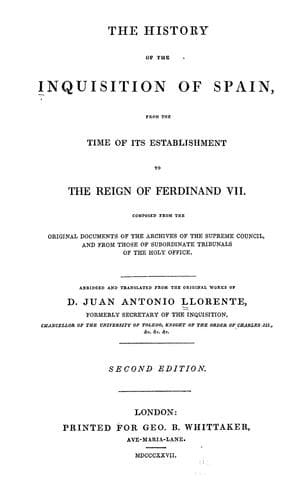
The History of the Inquisition of Spain from the Time of its Establishment to the Reign of Ferdinand VII.Llorente, Juan Antonio
History
The History of the Inquisition of Spain from the Time of its Establishment to the Reign of Ferdinand VII.
Llorente, Juan Antonio
Inquisition -- Spain
The inquisitor-general, in concert with the council, appointed different
theologians as qualifiers in the trial of Arias, and remitted to them
the denunciation of de Castro and his apology, the reply of the accused,
and the two writings of Estrada and Chacon. The principal censor was
Juan de Mariana, a Jesuit, who was considered very learned in the
oriental languages, and in theology. This choice, in which the Jesuits
had some influence, induced them to suppose that Arias would be
condemned. They were, however, disappointed; for though Mariana declared
that the Polyglott Bible was full of errors and inaccuracies, he
acknowledged that they were of no importance, and were not deserving of
theological censure. This decision induced the council to pronounce in
favour of Arias, who was soon after informed that he had gained his
cause at Rome. Mariana was never forgiven by the Jesuits for his
impartiality, and they afterwards made him a victim of the Inquisition.
_Doctor Don Diego Sobaños_, rector of the university of Alcala, a
theologian of the third convocation of the Council of Trent, not only
expressed a favourable opinion of the Catechism of Carranza, but chiefly
by his ascendancy over the theologians of his university, induced them
to approve the work. He was tried by the Inquisition of Valladolid, and
condemned to a pecuniary penalty, and to be absolved _ad cautelam_, from
the censures which he had incurred by approving the Catechism.
_Diego Lainez_, born in Almazan, in the diocese of Siguenza, second
general of the Society of Jesus, was denounced to the Inquisition as
suspected of Lutheranism, and the heresy of the _illuminati_. The
Jesuits did not pardon Valdés for having prosecuted their general, and
they contributed to his dismission in 1566. Diego Lainez, who was at
Rome, succeeded in evading the jurisdiction of the Inquisition of Spain.
_Fray Juan de Regla_, a Jeronimite, who had been confessor to Charles
V., and provincial of his order in Spain, theologian of the Council of
Trent at the second convocation, was arrested by the Inquisition of
Saragossa, on the denunciation of the Jesuits, as suspected of
Lutheranism: he abjured eighteen propositions, was absolved and
subjected to a penance.
Public-domain text, read in full here on John Shaqi.
Reviews
Reviews
No reviews yet
Be the first to share your thoughts on this work.
Elsewhere in the archive
Join the Discussion
Join the discussion
Sign in to leave a comment or review.
Sign InorCreate an account