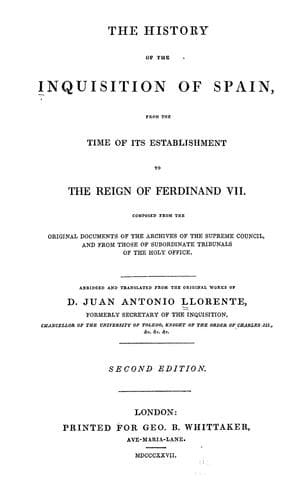
The History of the Inquisition of Spain from the Time of its Establishment to the Reign of Ferdinand VII.Llorente, Juan Antonio
History
The History of the Inquisition of Spain from the Time of its Establishment to the Reign of Ferdinand VII.
Llorente, Juan Antonio
Inquisition -- Spain
_Fray Francisco Villalba_, a Jeronimite of Montamarta, born at Zamora,
was one of the theologians at the second Council of Trent, and preacher
to Charles V. and Philip II. He attended the emperor at his death, and
pronounced his funeral oration. Philip II. had often consulted him. The
Inquisition of Toledo began an action against him as a Lutheran, and
being descended from the Jews. This arose from the envy of some monks of
his order, who denounced him. The general of his order, and his
coadjutors, made inquiries on the genealogy of Villalba, and discovered
that he was not descended either from the Jews or any persons punished
by the Inquisition. The protection of the king prevented the Inquisition
from obtaining witnesses soon enough to substantiate the charges, and
they did not dare to arrest him without further information. At this
period, in 1575, Villalba died at the Escurial, leaving, among honest
Spaniards, the reputation of being a good Catholic.
_Fray Michel de Medina_, a Franciscan, was a theologian of the third
convocation of the Council of Trent. He was born at Benalcazar, and
became a member of the college of St. Peter and St. Paul at the
university of Alcala, and guardian of the convent of Franciscans at
Toledo; he died in 1578, in the secret prisons of that city, after
having been sentenced as suspected of professing the opinions of
Luther. This accusation was occasioned by his great esteem for the
theological writings of Fray Juan de Fero, a monk of his order. He
published some of his works, which were denounced to the Inquisition,
and Medina wrote an apology for them, which was placed in the index by
Cardinal Quiroga, in 1583. Nicolas Antonio has given notices of some
works of Medina, and asserts that he justified himself on his doctrine.
This statement is inaccurate, for Medina was declared to be suspected,
and however innocent he may be supposed, his works were condemned, and
he would have been obliged to abjure and receive absolution _ad
cautelam_, if death had not arrested the progress of his trial.
_Fray Pedro de Soto_, a Dominican, confessor to Charles V. and first
theologian of Pope Pius IV. in the third convocation of the Council of
Trent. He was persecuted by the Inquisition of Valladolid in 1560, on
suspicion of Lutheranism: this suspicion was founded on the declarations
of some accomplices of Cazalla, of the favourable opinion given by Fray
Pedro on the Catechism of Carranza, of his letters to the archbishop,
his efforts to induce Fray Dominic de Soto to retract his first opinions
of the work, and to approve it, and on what he said at the council.
Pedro de Soto was not arrested, as he died at Trent in 1563, during the
first forms of his trial. He was taken by Philip II. to England, to
labour in the cause of religion. Nicolas Antonio mentions his works.
Public-domain text, read in full here on John Shaqi.
Reviews
Reviews
No reviews yet
Be the first to share your thoughts on this work.
Elsewhere in the archive
Join the Discussion
Join the discussion
Sign in to leave a comment or review.
Sign InorCreate an account